How to position a privacy-first product in a crowded market
A privacy-first promise only works when the proof is visible. Lessons from building PDFTry into a sharper category play in a crowded PDF market.
 Niels Kaspers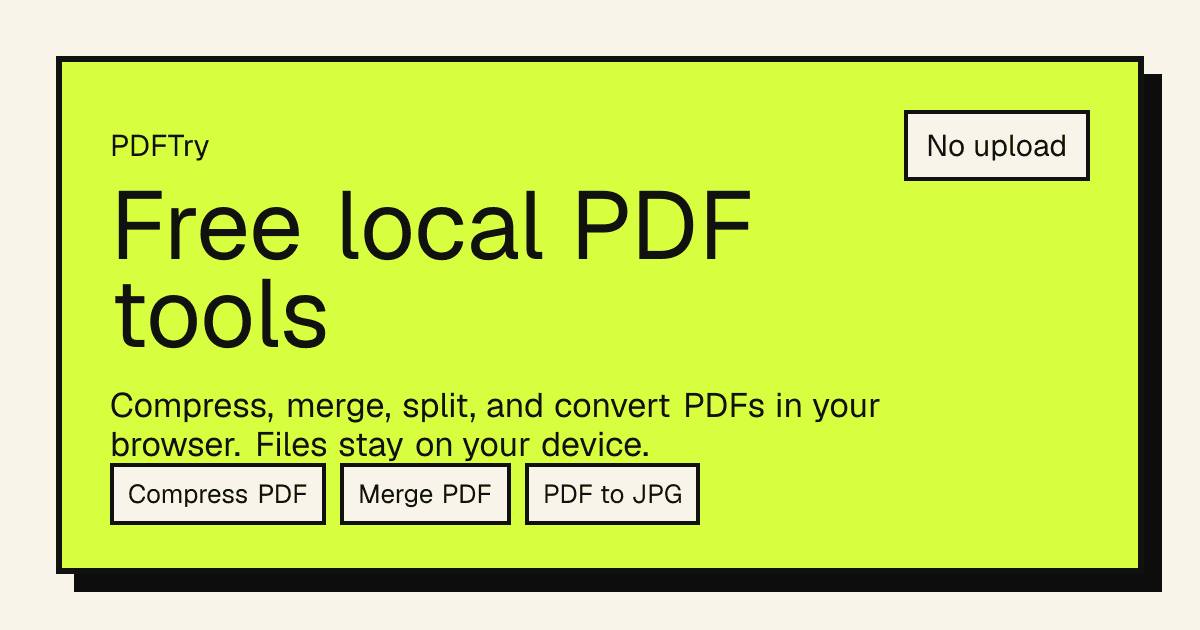
TL;DR
In a crowded software category, privacy is not enough as a slogan. The positioning gets stronger when the claim is backed by visible technical proof, cleaner category language, and site architecture that keeps repeating the same promise.
If you are entering a crowded software category, the biggest mistake is usually not weak features.
It is weak clarity.
That is the lesson I keep relearning with PDFTry.
The product itself is straightforward: browser-local PDF tools built around a privacy-first promise. No account wall. No watermark. No cloud upload for the listed workflows. Right now the surface covers 34 tools, and the differentiator is not supposed to be novelty for novelty's sake. It is that the trust model is part of the product.
That sounds simple on paper. It gets much harder the moment you try to position it in a category full of generic promises, feature grids, and near-identical landing pages.
So if you want the short answer to how to position a privacy-first product in a crowded market, mine is this: pick one trust claim, make the proof visible, and let the whole surface repeat it.
That is what made the PDFTry story sharper.
Privacy is not a position until the product makes it believable
A lot of products say they care about privacy.
That does not mean privacy is actually doing positioning work.
In a crowded category, a claim only matters when the reader can answer three questions quickly:
- what is different here
- why should I believe it
- what does that difference let me do next
That is where privacy-led positioning usually breaks.
Teams stop at the slogan.
They add a line about security, maybe a badge, maybe a footer note, and then expect the market to infer the rest. But if the underlying product flow still looks like every upload-first tool, the trust claim feels decorative.
PDFTry forced the opposite discipline.
The product promise is not just "we respect privacy." The more useful claim is simpler and more operational: your PDF stays on your device while the tool runs in the browser.
That sentence does real work.
It explains the architecture. It explains the emotional benefit. It explains why this surface deserves to exist in a crowded PDF market.
MDN's documentation on the File System API makes the technical layer legible too. Modern browsers can now read, write, and handle local files with explicit user permission, which means browser-local file workflows are not a gimmick anymore. Chrome's File System Access API guide shows the same shift from the implementation side: opening, editing, and saving local files in the browser is now a credible product capability.
That matters for positioning because the product story becomes believable. The message is no longer "trust us." The message is "this is how the workflow works, and that workflow changes the privacy tradeoff."
Crowded categories reward sharp contrast more than broad completeness
When a category is dense, there is always a temptation to sound bigger.
More features. More adjectives. More use cases. More audience segments.
Most of the time that weakens the position.
The cleaner move is usually sharper contrast.
With PDFTry, the wrong framing would have been "an all-in-one PDF platform for everyone."
That sentence is broad enough to include everything and distinct enough to mean almost nothing.
The better framing was narrower: private PDF tools that stay in the browser.
The reason I like that line is not just marketing taste. It changes product decisions.
Once you commit to that position, a lot of downstream choices get easier:
- which workflows belong on the surface
- which explanations need to appear above the fold
- which comparison pages are worth building
- which technical proof has to be visible
- which trust objections deserve their own page sections
This is also where the overlap with SEO becomes useful. In Programmatic SEO still works, but only if the page earns trust, I argued that strong pages need a visible trust layer, not just a keyword wrapper. Product positioning works the same way. If the promise does not show up in the architecture, the page may still be complete but it will not feel earned.
Crowded categories are brutal on generic language. They are surprisingly forgiving when the contrast is clean.
The category language should be understandable before it is clever
One thing I keep seeing builders get wrong is trying to invent a category phrase too early.
That can work later. It is usually weak as the opening move.
If you need the market to translate your category before it understands your product, you are already paying a comprehension tax.
The better move is to start with language the user already recognizes, then sharpen it with one clear difference.
That is why I like "PDF tools" more than a made-up productivity label.
The known category does one job: it tells the reader where to file the product.
The differentiator does the next job: it tells the reader why this version matters.
So instead of trying to coin a clever category from scratch, the position becomes:
- category: PDF tools
- differentiator: private, browser-local, no upload required for the listed workflows
That is boring in a good way.
It lowers the cognitive cost.
It also travels better in search, in social previews, and in AI summaries, where clarity beats novelty most of the time.
The market is moving this way too. PDFgear's April 2025 launch announcement for local-processing online PDF tools is useful here not because it proves who wins the category, but because it shows the category is becoming legible. Browser-local privacy is now visible enough to be a real comparison axis.
That gives a product like PDFTry a better opening. The job is no longer inventing demand from scratch. The job is making the position sharper and more believable than the generic alternatives.
The strongest positioning proof is often product behavior, not marketing copy
This is the part I care about most.
The best category positioning usually feels obvious when you use the product.
That means the proof has to show up in the product behavior itself.
For PDFTry, that includes:
- the browser-local processing model
- the absence of an account wall
- the absence of a watermark on the free surface
- the breadth of the workflow set around the same core trust promise
- the privacy and security explanation that makes the architecture explicit instead of implied
Those details matter because they stop the promise from floating.
A lot of positioning gets weak because it is disconnected from the operational reality of the product. The headline says one thing, the UX says another, and the page structure says a third.
That inconsistency is expensive.
Users notice it. Search quality signals notice it. AI systems notice it too when they try to summarize what the product actually is.
This is one reason I still like product-led surfaces so much. At Quicktools, the lesson was never just "make more pages." The deeper lesson was that high-intent surfaces work better when the utility and the positioning agree. That is the same reason 0 to 10M users: The Quicktools playbook still matters as an internal reference here. The page promise worked because the product job was real.
Positioning gets stronger when the product keeps proving the claim without needing extra explanation.
Information architecture is part of the position
A lot of people treat positioning like a homepage problem.
It is not.
It is a surface problem.
If the promise is real, it should appear in more than one place:
- the product page headline
- the feature and tool pages
- the trust or privacy explanation layer
- the comparison language
- the internal links between related workflows
That is why I do not think of positioning as only messaging. I think of it as routing.
A strong position should help the user move through the surface without losing the main idea.
In PDFTry's case, the main idea is not simply "here are many PDF tools." It is "here is a set of PDF workflows built around a safer, simpler operating model."
That changes what the internal links are supposed to do. They are not just there for crawl depth. They are there to keep reinforcing the category logic.
The user who lands on one tool page should be able to discover adjacent workflows without losing the privacy-first frame. The same principle applies to AI systems and search engines trying to understand the surface. A coherent internal route makes the position easier to extract.
That is the same reason I care so much about entity clarity and internal linking in How to structure pages for AI citations and real conversions. The page does not just need facts. It needs a legible reason to exist on this domain.
What changed once the promise got sharper
The most useful outcome was not some magical growth spike.
It was decision clarity.
A sharper position made it easier to choose what to build, what to say, and what to cut.
When the promise is vague, every adjacent idea sounds plausible. You can justify any feature, any landing page, any comparison, any piece of copy.
When the promise is sharper, the product gets stricter.
Questions become easier:
- Does this workflow strengthen the browser-local trust story or dilute it?
- Does this page make the no-upload promise more credible or more confusing?
- Does this comparison help the user understand the tradeoff or just add noise?
- Does this description sound like a real operating model or like SaaS wallpaper?
That kind of clarity compounds.
It helps the build surface. It helps the content surface. It helps the search surface. It helps the reader understand why the product is here.
And in crowded categories, that is often the real battle.
Not feature parity.
Interpretation.
My rule for privacy-first positioning
If you want privacy to be the position, not just a supporting value, run it through this test:
- Can the user describe the workflow difference in one sentence?
- Can the product behavior prove that sentence quickly?
- Can the page architecture keep repeating that sentence without sounding forced?
- Does the trust claim naturally narrow what you build next?
- Would the position still feel real if you removed the word privacy and looked only at the product flow?
If the answer is no, the claim is probably still too abstract.
That is why I prefer operational promises over moral language.
"We care about privacy" is a value statement.
"Your file stays on your device while the tool runs in the browser" is a product statement.
The second one is much stronger.
Interactive
Privacy-first positioning audit
Use this when a crowded category makes your product sound interchangeable.
Completion
This is the gap between understanding the article and actually using it.
- Use this block as the practical summary, not just the article ending.
- If one item feels vague, the article probably needs sharper guidance.
- A short checklist beats a long recap when the reader needs to act.
What I would do before scaling the surface further
If I were expanding a product like this, I would pressure-test five things before chasing more volume.
1. Tighten the comparison axis
Do not compare on everything. Compare on the trust tradeoff you actually own.
2. Make the proof more explicit
If the architecture is the differentiator, explain it plainly.
3. Build the next pages around real user jobs
Category clarity gets stronger when each page does one obvious thing well.
4. Keep the internal routes coherent
Every adjacent page should reinforce the same operating model, not just the same keyword family.
5. Resist the urge to broaden the message too early
A narrow believable position usually beats a broad forgettable one.
That is especially true when the category already has bigger incumbents.
My broader take
Most crowded markets do not have an information shortage.
They have a trust and clarity shortage.
That is why I think privacy-first positioning only becomes interesting when it is translated into product behavior, category language, and site structure.
PDFTry made that lesson hard to miss for me.
The strongest version of the story was never "we also have PDF tools."
It was "we built a PDF surface around a different operating model, and the whole product keeps proving it."
That is the kind of position that gives you a chance in a crowded market.
Not because it sounds louder.
Because it is easier to believe.
FAQ
What makes a privacy-first product position believable?
A privacy-first position becomes believable when the workflow itself proves the claim. The strongest version is not a slogan about values. It is a visible product behavior that changes the user's trust tradeoff.
Should founders invent a new category phrase for a privacy-first product?
Usually not at first. Start with category language the user already understands, then sharpen it with one clear differentiator. Clarity beats cleverness early on.
Why does information architecture matter for product positioning?
Because the position should survive beyond the homepage. Tool pages, product pages, trust explanations, and internal links should all reinforce the same promise so the surface feels coherent.
Is privacy enough to win a crowded software category?
Not by itself. Privacy only becomes a position when it is paired with clear proof, useful workflows, and a simpler explanation of why this product exists versus the alternatives.