What building PDFTry taught me about category positioning
PDFTry made a crowded PDF category easier by leading with a no-upload trust promise. Here is what that changed in the product, page structure, and supporting content.
 Niels Kaspers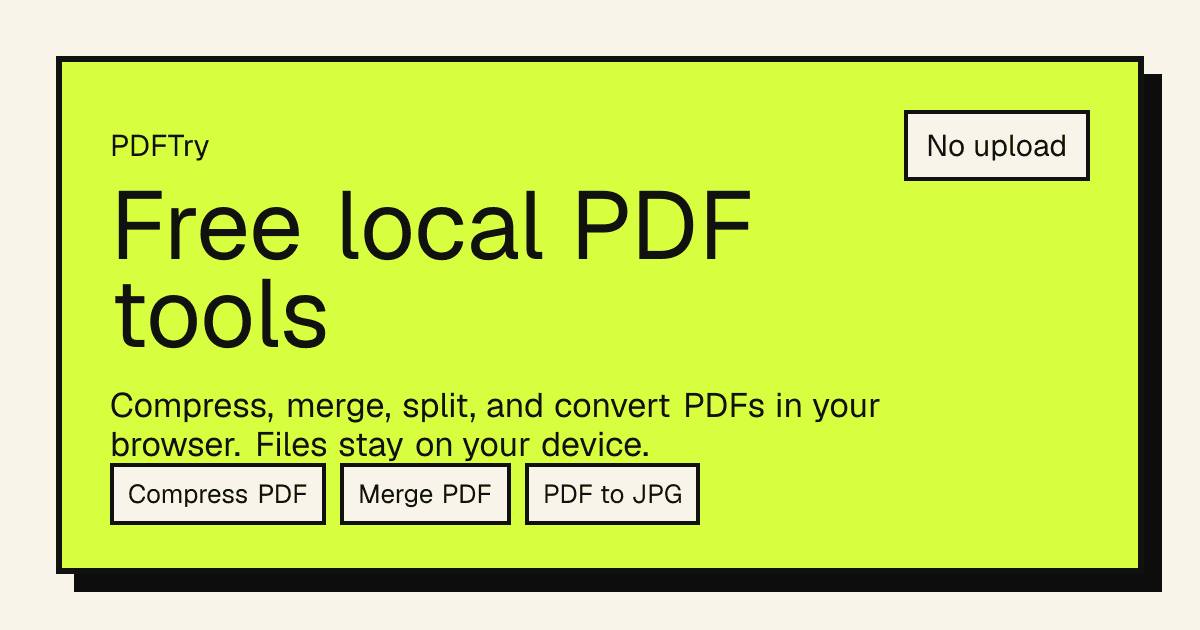
TL;DR
PDFTry got more interesting when the position stopped being generic PDF utility breadth and became a plain trust promise: private PDF tools that stay in the browser. That single choice shaped the copy, route structure, supporting content, and what deserved to exist on the site at all.
Most crowded categories do not have a traffic problem first.
They have a sameness problem.
That was the real lesson for me while shaping PDFTry, a live product built around private PDF tools that stay in the browser.
The early temptation in a category like PDF tools is obvious. Add more tools. Add more keywords. Add more pages. Sound more complete than the next site.
But that is exactly how you disappear.
The category is already full of products that compress into the same vague promise: convert, merge, compress, sign, and hope people trust you enough to upload the file.
PDFTry only started to feel positionable when the promise got narrower and sharper: your files stay in the browser.
That is not just a tagline choice. It changes the whole product and content system.
It changes what the homepage needs to say, what the category pages need to prove, what objections the product flow has to resolve, and which supporting pages actually deserve to exist.
If I had to compress the lesson into one line, it would be this.
Category positioning gets easier when the promise is concrete enough to shape the product, not just the copy.
The problem with generic category language
In utility software, generic copy feels efficient because it maps neatly to keyword demand.
You can write the familiar sentence in five minutes: fast online PDF tools for every workflow.
The issue is not that the sentence is wrong.
The issue is that it could belong to almost everyone.
In categories like PDF tools, screenshot apps, note apps, AI assistants, or browser extensions, the market is usually oversupplied with surfaces that all sound complete and convenient. If your page sounds like every other page, the user has to do the differentiation work themselves.
That is bad for conversion.
It is also bad for search and AI-era discovery. Google's current AI optimization guide still pushes the same underlying rule: useful pages win when they add clear value and make their purpose legible. A page that says the same thing as ten competitors gives search systems very little reason to carry your version forward.
That matters even more when the category asks for trust before the product has earned it.
PDF tools do exactly that. The category convention is: upload the file first, trust us second.
That is why a generic convenience position felt weak.
Convenience was already abundant.
Trust was not.
Why the no-upload promise mattered more than breadth
The better category story for PDFTry was not "we have lots of PDF tools." Plenty of sites can say that.
The better story was "you do not need to upload your files for the listed workflows."
That changes the emotional starting point.
Instead of asking the user to compare tool breadth, pricing, or micro-features first, it gives them a more basic answer to a more important question.
Is this the kind of product I should trust with my documents?
That is a positioning move, not a compliance paragraph.
Google's privacy-first marketing guidance makes a similar broader point: users want companies to treat privacy as part of the experience, not as a legal afterthought. Privacy-first only becomes real when product, marketing, and legal logic all point in the same direction. The idea is not "say privacy more often." The idea is to make the trust promise visible in the experience itself.
That is also why the PDFTry position had to be plain.
No-upload is a phrase normal people understand quickly.
Browser-local processing is more precise in some contexts, but it is not the first sentence I would lead with. Category positioning needs a phrase that survives the first three seconds.
Then the product and supporting pages can cash it out with more detail.
The product has to prove the position early
This is where a lot of category positioning fails.
Teams find a decent angle, then leave it stranded in the hero section.
The user clicks deeper and the position disappears.
With PDFTry, the trust promise only matters if the product flow keeps reinforcing it.
That means the product cannot make the user wait until a buried FAQ or privacy page to learn what happens to their file.
The promise has to show up where the anxiety actually lives.
For this category, that means around:
- the product description
- the tool entry points
- the upload or file-select moment
- the explanation of what runs locally and what does not
- the supporting privacy and security context
That is one reason I keep coming back to Why your product page needs a context layer, not just a feature grid. Product pages in trust-sensitive categories need to answer the mental objection before they push the feature list. The category promise is only useful if the user can verify it while they are making the decision.
That is also why I would rather have fewer, sharper claims than a wider wall of vague benefits.
A generic surface says everything.
A real position usually says one important thing, repeatedly, until the user believes it.
Positioning should shape the content architecture too
The category lesson was not only about the product page.
It also changed what kind of supporting content made sense.
If the position is trust-led and privacy-led, then the content architecture has to do more than attract broad "PDF tool" demand. It has to route users from generic task intent into the specific trust angle that makes the product different.
That means the job is not just to publish a lot of utility pages.
The job is to create a structure where the user can move from:
- a task page
- to a trust explanation
- to a product surface that proves the promise
- to the next adjacent workflow without losing the positioning thread
That is why Programmatic SEO still works, but only if the page earns trust matters here. Programmatic or scaled surfaces can still work, but only when the page is doing something more useful than rephrasing the category. In PDFTry's case, the useful layer is not just tool coverage. It is clarity about how the work happens and why that matters.
Once you accept that, some pages become more valuable and some become easier to kill.
A page that repeats generic utility language without proving the no-upload angle is not helping the position.
A page that explains why browser-local processing changes the trust equation probably is.
Trust is a category wedge when it is observable
This is the most important distinction.
Trust is not a wedge because brands keep saying they care about it.
Trust becomes a wedge when the user can observe the difference.
That can come from the flow itself.
It can come from the copy around the flow.
It can come from the supporting documentation.
It can come from the architecture of the site.
But it has to be observable.
That is why the market has become less forgiving of empty privacy language. The latest TrustArc 2026 Global Privacy Benchmarks Report points in the same direction at a broader organizational level: privacy maturity is uneven, and the teams that treat it as an integrated operating capability are stronger than the ones that bolt it on. At the category level, users read that maturity more simply. They ask whether your product looks believable.
For a PDF tool, believable means the promise is visible before the user takes the risky step.
That sounds basic.
It is also where a lot of software still loses.
Category positioning is easier when you name the enemy clearly
Another thing PDFTry clarified for me is that a product position gets stronger when the contrast is obvious.
The contrast here was not another specific PDF competitor.
The contrast was the default category behavior.
Upload-first, cloud-copy, low-context utility sprawl.
PDFTry did not need to attack every competitor by name.
It just needed to make the alternative legible.
Your files stay on your device for the listed tools.
That one contrast does a lot of work.
It defines the threat.
It explains why the promise matters.
It gives the supporting content a spine.
It also improves conversion language because the product is not forced to compete only on breadth, price, or design.
It can compete on category logic.
That is usually stronger.
Why this matters for builders outside PDF tools too
The PDFTry lesson is not really about PDF tools.
It is about any crowded software category where the feature list is easy to copy and the trust decision happens early.
That includes:
- AI tools asking for sensitive context
- analytics or marketing products asking for scripts and data access
- browser extensions asking for broad permissions
- creator tools asking for file uploads
- B2B workflows that touch customer records
In all of those categories, a lot of teams still position from the inside out.
They describe the system they built.
Users buy from the outside in.
They want to know what risk disappears, what friction drops, and why this product should be trusted faster than the generic alternative.
That is why I think How to position a privacy-first product in a crowded market and How I rebuilt nielskaspers.com as an AI landing page belong in the same broader cluster. The first is about the angle. The second is about making the angle legible on the site. PDFTry is the product receipt that connects the two.
The trap: overclaiming privacy until the position breaks
There is one obvious way to ruin a trust-led category position.
Overclaim it.
If your page implies a stronger guarantee than the product can actually support, the category wedge flips into a liability.
That is why I like precise promises more than sweeping ones.
"No upload for the listed workflows" is stronger than a blurry universal claim about perfect privacy everywhere.
The more trust-sensitive the product, the more careful the wording has to be.
Category positioning gets better when the promise is strong enough to matter and narrow enough to defend.
That is not less ambitious.
It is more durable.
The system I would use again
If I had to reuse this lesson on the next crowded-category product, I would follow a simple order.
First, find the anxiety that happens before the feature comparison.
Second, turn that anxiety into a plain-English promise.
Third, make the product flow prove the promise early.
Fourth, let the content architecture route generic intent into that promise instead of flattening everything into generic category copy.
Fifth, remove or rewrite pages that attract traffic but do not reinforce the position.
That is what I mean when I say category positioning should shape the product.
The point is not to write a better slogan.
The point is to choose a promise that changes what deserves to exist.
A quick audit for trust-led positioning
Interactive
Trust-led category positioning audit
Use this before you ship another crowded utility product that sounds like everyone else.
Completion
This is the gap between understanding the article and actually using it.
- Use this block as the practical summary, not just the article ending.
- If one item feels vague, the article probably needs sharper guidance.
- A short checklist beats a long recap when the reader needs to act.
My take
The reason PDFTry became easier to position is not that it entered a fresh category.
It entered a stale one with a better contrast.
That is usually the more interesting move.
In crowded markets, breadth sounds impressive inside the team and forgettable outside it.
A concrete promise gives the market something to hold on to.
For PDFTry, that promise was simple: private PDF tools that stay in the browser.
Everything got easier once that sentence started acting like a product rule instead of a marketing line.
That is the part I would reuse.
FAQ
What is category positioning in a crowded software market?
It is the job of making your product's value legible in a category where many alternatives sound the same. In practice, that usually means leading with a sharper promise than generic convenience or feature breadth.
Why is trust a good category wedge?
Trust works when the user has to take a meaningful risk early, like uploading a file, granting permissions, or sharing sensitive context. If your product can reduce that risk in a visible way, the position becomes easier to understand and easier to believe.
How do you know if a positioning angle is too generic?
If the sentence could sit on five competitor homepages without changing meaning, it is too generic. The better question is whether the promise changes the product flow, the page structure, and the kind of supporting content you need.
Does privacy-first positioning only work for security products?
No. It can matter in any category where users feel uncertainty before using the product. The important part is that the claim is precise and observable, not that the market uses privacy language all the time.
What did PDFTry do differently?
The stronger difference was not just having many PDF workflows. It was packaging the product around a no-upload trust promise and letting that promise shape the pages, routing, and support context around the tools.