
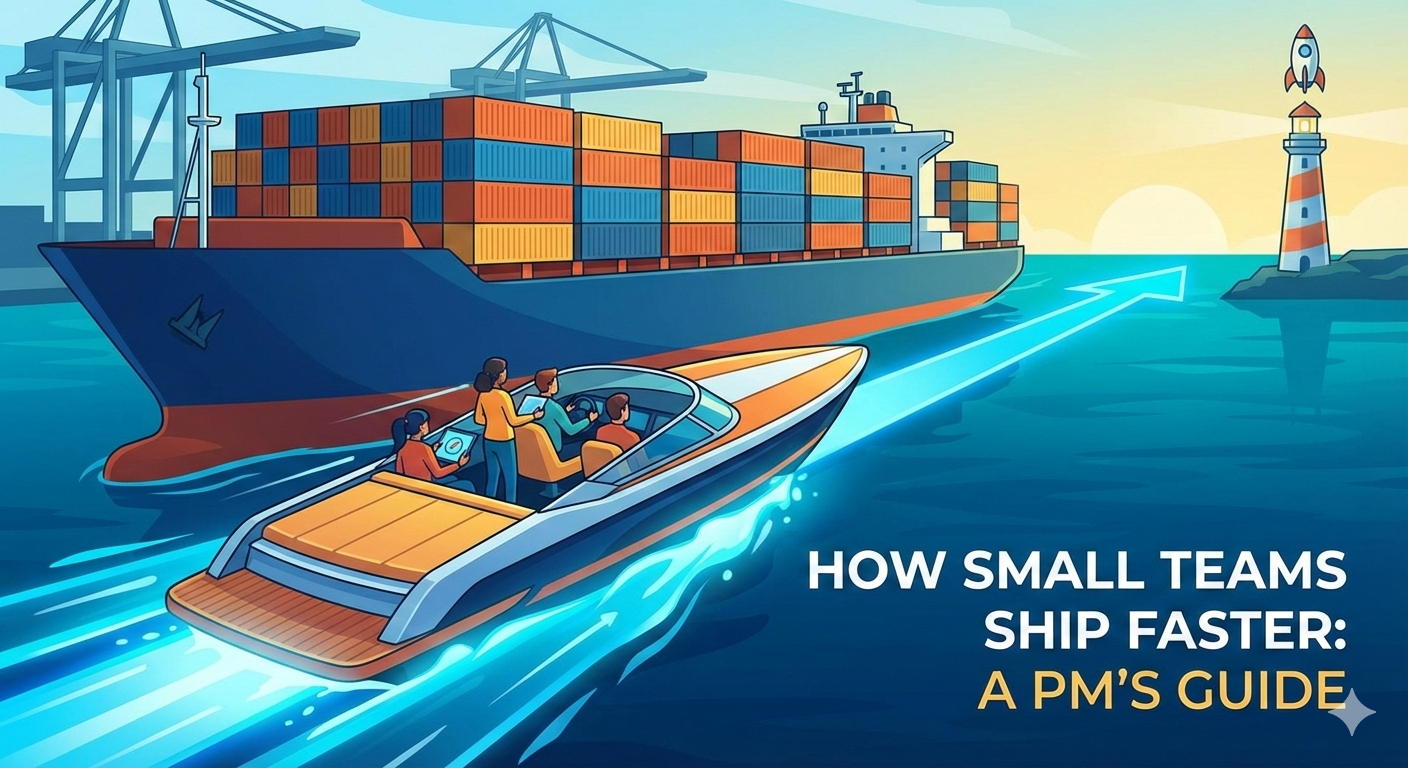
Why Do Small Teams Often Ship Faster Than Large Ones?
Small teams ship faster because they spend less time coordinating and more time building. A team of 2-3 people can make decisions in a Slack thread that would require a meeting, a document, and three approvals in a larger organization.
This isn't about working harder or longer hours. It's about the physics of communication. When you add people to a team, you don't just add capacity—you add coordination cost. Every new person creates new communication paths, new opinions to align, new calendars to navigate.
Jeff Bezos famously called this the "two-pizza team" rule: if a team can't be fed with two pizzas, it's too big. But the insight isn't really about pizza. It's about keeping the coordination cost low enough that most of your time goes into actual work.
The math that explains everything
In a team of 2, there's 1 communication path.
In a team of 5, there are 10 communication paths.
In a team of 10, there are 45 communication paths.
Each path is a potential delay, misunderstanding, or meeting. Large teams aren't slow because the people are slow. They're slow because the system is slow.
What small teams sacrifice (and why it's worth it)
Small teams can't do everything. You'll have less specialization, fewer redundancies, and more single points of failure. If your one backend engineer gets sick, you're blocked.
But for most early-stage products and growth experiments, this tradeoff is worth it. Speed of learning beats comprehensiveness. Shipping something imperfect and iterating beats planning something perfect and never launching.
The question isn't "should we have a small team?" It's "what are we optimizing for?" If it's learning and iteration, small wins. If it's reliability and coverage, you need more people.
What Framework Actually Increases Shipping Velocity?
The framework that works is simple: identify your repeating pattern, then make that pattern cheap to execute.
In 2022, I joined Picsart to build Quicktools—a suite of free web tools to acquire organic traffic. We had no roadmap, no team, and an ambitious goal: build enough tools to reach 10M monthly users.
The breakthrough wasn't working harder. It was recognizing that every tool we'd build would have the same structure: landing page, upload flow, processing step, download. Once we saw that pattern, we invested our first month building a framework that made each new tool a configuration exercise rather than a coding project.
What to standardize
Standardize the parts that aren't differentiated:
- Design system: One flexible system, applied everywhere. No custom designs per feature.
- Tech architecture: Pick once, commit fully. Every tool uses the same stack.
- Documentation format: Same structure for every spec. Engineers know where to look.
- QA process: Same checklist, same acceptance criteria format.
- Launch process: Same announcement template, same monitoring setup.
The goal isn't to remove creativity. It's to remove the decisions that don't add value. Your creativity should go into the core product, not into debating which button library to use this time.
What decisions to eliminate

Every decision is a potential delay. Eliminate the ones that don't matter:
- "How should we build this?" → Already decided. Use the framework.
- "What should it look like?" → Already decided. Use the design system.
- "Where should we document it?" → Already decided. Same place as everything else.
- "Who needs to approve this?" → Already decided. Minimize approval chains.
The best teams I've worked with have a bias toward convention. "We do it this way because we always do it this way" sounds anti-innovative, but it's actually what enables innovation. When the boring stuff is automatic, you can focus your energy on the interesting problems.
The shipping rhythm that compounds
We settled into a predictable rhythm: two complete tool flows shipped per week. Monday we scoped, Tuesday through Thursday we built, Friday we shipped and monitored.
This wasn't sustainable because we were grinding. It was sustainable because we'd removed the variability. Every week looked the same. No surprises, no "what are we working on again?" conversations, no context-switching between wildly different projects.
When you know exactly what you're building and exactly how you're building it, speed becomes a side effect of clarity.
What Should You Cut to Move Faster?
Cut decisions, not quality. Cut scope, not corners.
Here's what we cut:
- Custom designs for each tool. The designer made the system flexible, not bespoke.
- Tech stack debates. We picked React and stuck with it. No Angular experiments.
- Feature creep. Each tool did exactly one thing. Background remover removes backgrounds. That's it.PM theater. Specs lived in shared docs, not elaborate JIRA epics. Engineers read them and started building.
- Meetings about meetings. Daily standups became async Slack updates.
What we didn't cut
- Code quality. Technical debt slows you down later. We kept standards high.
- User research. We still talked to users, just faster—quick surveys, session recordings.
- Testing. Broken tools destroy trust. We tested everything before launch.
- Analytics. We shipped with tracking from day one. No "we'll add analytics later."
The distinction matters. Cutting the wrong things creates speed now and slowness later. Cutting the right things creates sustainable velocity.
The scope question
Here's a useful reframe: instead of asking "what features should this have?" ask "what's the smallest version that's still useful?"
A background remover that removes backgrounds is useful. A background remover that also lets you replace backgrounds, adjust edges, batch process, and export in multiple formats is a different product entirely.
Most features exist because someone imagined a user wanting them, not because users actually asked. When you're small and fast, you can ship the simple version, see if anyone cares, and add complexity only if the demand is real.
How Do AI Tools Change This in 2025?
AI tools have dramatically lowered the cost of prototyping and iteration. What used to require engineering time can now be tested in hours by a PM working alone.
What's different now vs. 2022
When we built Quicktools in 2022, prototyping meant either waiting for engineering or building hacky no-code versions that couldn't scale. Every experiment required coordination.
In 2025, the landscape is different:
OpenAI reportedly had four engineers convert their Sora app from iOS to Android in a month by running multiple Codex instances simultaneously—essentially turning a team of 4 into a team of 16 virtual engineers.
What PMs can now prototype without engineers
This is the real shift. PMs can now validate ideas before consuming engineering resources:
- Landing pages: Build and test conversion before committing to development.
- Workflows: Use n8n or Zapier with AI to prototype automation logic.
- Data products: Use AI to analyze datasets and generate insights.
- Content at scale: Generate and test content variations.
- User research synthesis: Summarize interviews and extract patterns instantly.
The goal isn't to replace engineers. It's to derisk decisions before involving them. If you can test whether an idea has legs in a day, you won't waste a sprint building something nobody wants.
The new bottleneck
Here's the uncomfortable truth: in 2025, the bottleneck often isn't engineering capacity. It's PM clarity.
AI tools are fast, but they need clear direction. A vague prompt produces vague output. The PMs who benefit most from AI aren't the ones with the best tools—they're the ones who can articulate exactly what they want to build and why.
If you find AI tools underwhelming, the problem might not be the tools.
How Do You Handle the Pressure to Ship Faster?
The pressure to ship faster is real, and it's not going away. Executives see AI demos and wonder why everything takes so long. Competitors launch features monthly. The market moves faster every year.
This pressure can be motivating or crushing depending on how you respond to it.
Why shipping velocity feels overwhelming
Most PMs feel overwhelmed not because they're slow, but because they're trying to move fast in a system
designed to be slow.
You might be:
- Fighting process instead of building product. Approvals, documentation, alignment meetings.
- Context-switching constantly. Every interruption costs 20+ minutes of recovery time.
- Saying yes to everything. Every commitment is a commitment against something else.
- Measuring activity, not outcomes. Busy isn't the same as productive.
- Working without a framework. Every decision takes full cognitive load.
The feeling of overwhelm is often a signal that the system needs fixing, not that you need to work harder.
What you should actually do about it
First: Audit where your time actually goes. For one week, track every task in 30-minute blocks. You'll probably find that "real work" is a smaller percentage than you thought. The gaps are your opportunity.
Second: Identify your repeating patterns. What do you do every week that looks basically the same? That's your candidate for systematization. Build a template, automate a step, or delegate it entirely.
Third: Negotiate your commitments. Every "yes" is an implicit "no" to something else. Get explicit about tradeoffs. "I can do X or Y this sprint, but not both. Which matters more?"
Fourth: Protect your building time. Block 2-4 hour chunks for deep work. Decline meetings that don't require your presence. Batch communications into specific times.
Fifth: Accept that you can't do everything. This isn't a productivity hack—it's a mindset shift. The goal isn't to do more. It's to do the right things.
A note on sustainable pace
Shipping fast doesn't mean burning out. The teams that sustain high velocity are the ones who've built systems, not the ones who are grinding.
If your shipping speed depends on heroics—late nights, weekend work, skipped breaks—it's not sustainable and it's not a model. Real velocity comes from removing friction, not from pushing harder through friction.
How Does This Translate to Everyday PM Impact?
Shipping velocity isn't valuable on its own. It's valuable because it enables faster learning, which enables better decisions, which enables actual impact.
The connection between velocity and outcomes
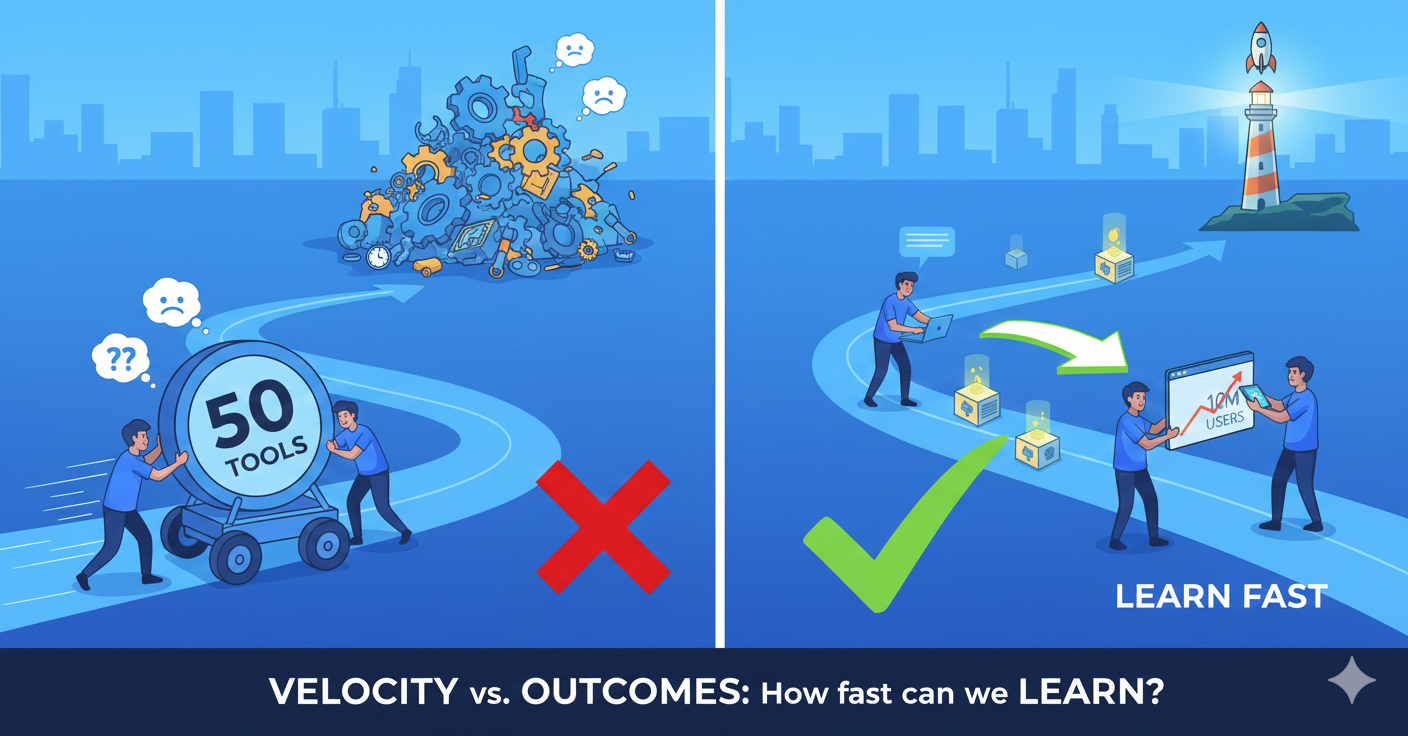
Here's what most velocity conversations miss: speed only matters if you're going in the right direction.
Shipping 50 tools in a year sounds impressive until you ask: did anyone use them? In our case, yes—we hit 10M monthly users. But I've also seen teams ship fast and build nothing of value.
The question isn't "how fast can we ship?" It's "how fast can we learn whether we're building the right thing?"
High velocity enables:
- Faster feedback loops. Ship, measure, learn, adjust.
- Lower cost of being wrong. Small bets, quick pivots.
- More experiments per quarter. The more you try, the more you learn.
- Compounding improvements. Each iteration builds on the last.
But velocity without direction is just chaos. You need both.
How to prioritize when everything feels urgent
The frameworks exist: RICE, ICE, impact/effort matrices. But frameworks don't solve prioritization—judgmentdoes.
Here's what actually helps:
Ask "what happens if we don't do this?" Most "urgent" things aren't actually urgent. If nothing bad happens by waiting a week, it's not urgent.
Distinguish between important and loud. Stakeholders with opinions aren't the same as customers with problems. Important work often doesn't have a champion yelling for it.
Default to reversible decisions. If you can undo it, decide quickly. Save your deliberation for one-way doors.
Limit work in progress. Three things in progress beats ten things in progress. Finishing work creates more value than starting work.
Protect your strategic bets. It's easy to let urgent requests consume all capacity. Block time specifically for important-but-not-urgent work.
The best prioritization isn't a framework—it's the discipline to say "not now" to good ideas so you can say "yes" to great ones.
What Are the Key Lessons That Apply Beyond Shipping?
The principles behind high-velocity shipping aren't just about shipping. They're about how to operate as a PM in a complex environment.
Lesson 1: Systems beat heroics
The PM who builds a system that works without them is more valuable than the PM who personally heroics everything across the finish line.
This applies to: documentation, stakeholder communication, team processes, decision-making, and literally everything else you do repeatedly.
Ask yourself: "If I disappeared tomorrow, would this keep working?" If not, you've built a dependency, not a system.
Lesson 2: Constraints breed creativity
We shipped 50 tools with 2 engineers not despite the constraint but because of it. The limitation forced us to find leverage instead of throwing resources at problems.
When you're tempted to ask for more—more engineers, more budget, more time—first ask: "What would we do if we had to solve this with what we have?"
Lesson 3: Decisions are the real bottleneck
Most slowdowns aren't technical. They're decisional. Waiting for alignment, waiting for approval, waiting for someone to decide.
Reduce decisions by creating conventions. Accelerate necessary decisions by clarifying who owns them. Eliminate unnecessary decisions by asking whether they actually matter.
Lesson 4: Ship to learn, not to be done
The goal of shipping isn't to finish—it's to learn. A shipped product generates feedback. An unshipped product generates nothing.
This reframe changes how you think about scope, quality, and timing. "Good enough to learn from" is often good enough to ship.
Lesson 5: Your job is leverage, not labor
As a PM, your value isn't in the work you do directly. It's in the work you enable, unblock, and multiply. Time spent making the team faster is usually more valuable than time spent doing tasks yourself.
The exception: when doing tasks yourself builds understanding you couldn't get any other way. Hands-on work has value—just not as your primary contribution.
Key Takeaways
- Small teams ship faster because they spend less time coordinating, not because they work harder
- The framework: identify repeating patterns, then make those patterns cheap to execute
- Cut decisions, not quality—standardize the boring parts so creativity goes into the core
- AI tools in 2025 let PMs prototype and validate before consuming engineering resources
- Shipping pressure is real—respond by fixing systems, not by grinding harder
- Velocity only matters if you're going in the right direction; speed + direction = impact
- Build systems that work without you; that's leverage, not labor
FAQ
How long does it take to set up a framework for faster shipping?
Typically 2-4 weeks of focused effort. You'll feel slow during setup—shipping nothing while competitors launch features. But the investment compounds: what takes 2 weeks to build once saves 2 days every time you ship after that. For us, a month of framework-building enabled shipping 2 tools per week for the rest of the year.
Can this approach work at a large company, or only at startups?
It works at large companies if you can create a small, autonomous team with clear ownership. The two-pizza team concept came from Amazon—one of the largest companies in the world. The key is protecting the team from organizational drag: minimize dependencies, clarify decision rights, and shield them from process overhead.
What if my engineering team resists standardization?
Engineers often resist standardization when it feels imposed rather than collaborative. Involve them in designing the framework, not just following it. Good engineers appreciate well-designed systems—they dislike arbitrary constraints dressed up as systems. The difference is whether the standardization makes their work easier or just makes management happy.
How do you balance shipping fast with technical debt?
Technical debt isn't inherently bad—it's a tradeoff. The question is whether you're taking debt consciously or accidentally. Ship fast when learning matters more than polish. Pay down debt when stability matters more than speed. The mistake is treating every situation the same way.
What AI tools are most useful for PMs trying to ship faster?
Start with what you already have access to: ChatGPT/Claude for writing, analysis, and brainstorming. Add n8n or Zapier for workflow automation. Use Framer or Webflow for landing page prototypes. The specific tools matter less than building the habit of asking "can AI do this first draft?" before doing it manually.
Sources
- Swarmia: How to Ship Software 10x Faster
- Inc: How OpenAI Ships Products Fast
- Mind the Product: Why Your CEO Ships Faster Than You
- n8n: AI Workflow Automation
- CXL: Answer Engine Optimization Guide
Author: Niels Kaspers
Published: 2026-01-04

.png)
.png)
.png)
.png)