How to evaluate product bets when AI makes prototyping cheap
A practical framework for PMs and solo builders to judge product ideas when AI makes prototypes fast, cheap, and dangerously easy to overvalue.
 Niels Kaspers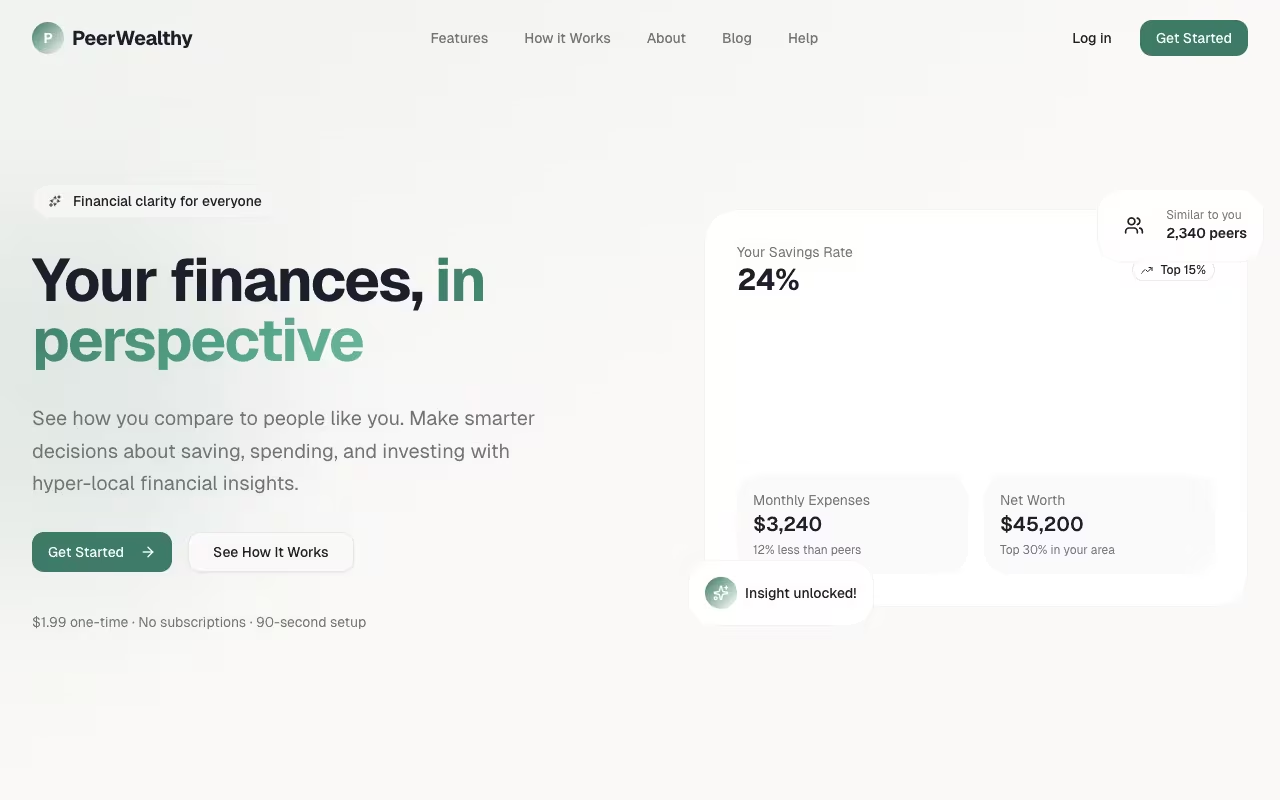
TL;DR
AI makes first prototypes cheap. The harder question now is whether a product bet teaches you something real fast enough to deserve a second round of investment.
If you want the short answer, evaluate product bets by the quality of learning they create, not by how quickly AI helps you ship the first artifact.
That is the shift.
When prototyping gets cheap, the first version stops being the main hurdle. The harder part is deciding whether the thing you built revealed a real user pull, a clearer positioning wedge, a stronger workflow advantage, or just gave you a satisfying demo.
In my own work, that difference keeps showing up across PeerWealthy, PMtivity, ScreenshotEdits, and this site. AI lowered the cost of producing the first version. It did not lower the cost of choosing the right bet.
That is why I think product teams need a better evaluation layer now. Recent product writing from Products That Count, IdeaPlan's learning velocity definition, and Parallel's AI product development piece all point in the same direction. Prototyping is faster. Learning is still the moat.
AI changed the cost of trying, not the standard for a good bet
A lot of teams are reading the current AI moment as permission to build more.
I think the better reading is that it gives you permission to learn faster.
Those are not the same thing.
A prototype is useful because it sharpens a decision. If it does not sharpen a decision, it is just a cheaper artifact.
That matters because AI now makes it easy to confuse movement with progress. A team can generate flows, landing pages, internal tools, onboarding drafts, and rough product surfaces in hours. The danger is that the lower build cost makes weak ideas feel more legitimate than they really are.
I wrote about the documentation side of this in Product spec vs PRD: what AI teams need in the agent era. The point was not that docs disappeared. The point was that artifacts became easier to create, so the evaluation layer had to become sharper. The same rule applies to product bets.
The question I ask first
Before I ask whether a product idea is exciting, I ask whether the next seven days can teach me something expensive to learn any other way.
That usually means one of four things:
- whether the problem is painful enough that people change behavior
- whether the positioning is sharp enough that the product is easy to explain
- whether the workflow creates repeatable value instead of one-time novelty
- whether the bet unlocks a stronger second move if the first signal is positive
If a prototype cannot answer at least one of those questions, I usually do not trust the enthusiasm around it.
That is one reason I still like building things myself as a PM. Why product managers should learn to build with code now was really a point about decision speed. When you can build the first pass yourself, you get to test the shape of the bet earlier. But you only win if you are honest about what the prototype did and did not prove.
My five-part scorecard for evaluating a product bet
This is the scorecard I keep coming back to.
1. Is the pain concrete enough to trigger a behavior change?
A bet deserves more time when the user problem is easy to spot in the wild.
For PeerWealthy, the tension was not abstract. People do not know whether they are doing well financially because the comparisons available to them are noisy, performative, and usually detached from local context. That is a cleaner pain statement than a broad claim like "personal finance needs disruption."
The more concrete the pain is, the easier it becomes to tell whether the early product is clarifying the job or drifting into feature theater.
2. Did AI reduce build cost, or did it reveal a real wedge?
This is where a lot of teams fool themselves.
AI can absolutely cut the time it takes to produce the first version. That matters. But the real question is whether the faster artifact exposed a stronger insight.
With ScreenshotEdits, the useful signal was not simply that a working app could be built quickly. The useful signal was that polished screenshots are a repeated workflow pain for developers, designers, and content creators, and that a native macOS tool creates a much cleaner promise than another generic design utility.
Speed helped reveal the wedge. Speed was not the wedge.
3. What did the prototype teach that a document could not?
If the prototype did not produce new information, the bet is weaker than it looks.
This is where I think a lot of AI-assisted product work still breaks down. People celebrate that the first artifact exists, but they do not ask what the artifact changed in the decision process.
For me, the good prototypes usually do one of three things:
- they expose a user objection earlier than expected
- they make the product promise sharper or narrower
- they change what the next build should be
If none of those happened, I probably learned less than I think.
4. Does the bet create repeatable proof, not just a fun demo?
A good bet gives you proof that can compound.
That proof might be usage, a stronger positioning story, repeatable behavior, clearer distribution language, or a more legible workflow. It should be something you can carry into the next decision.
This is one reason I care so much about building products and content surfaces together. A bet gets stronger when it can produce both product learning and proof language around it. Pieces like How I use Claude Code to build products as a PM and What PMtivity is teaching me about building with a small team work because they turn first-party build loops into reusable operating lessons.
5. If this works, what becomes easier next?
The best bets unlock a second move.
Maybe the second move is a better landing page, a cleaner onboarding flow, a stronger niche, a more specific audience, or a more defensible workflow system. I want to know whether a positive signal compounds or just flatters me.
That is also why I do not only judge a bet by current size. I judge it by adjacency. Does it open a stronger path into a product line, a content cluster, a repeatable system, or a better positioning layer?
What I watch for instead of raw excitement
Excitement is useful. It gets the work moving.
It is also one of the easiest signals to overrate when AI cuts effort.
The stronger signals for me are usually:
- someone describes the value back in their own words
- the positioning gets easier after the prototype, not harder
- the next feature becomes more obvious because the first job was clear
- the product creates a repeatable usage pattern instead of one pleasant surprise
- saying no to adjacent ideas becomes easier because the core bet is sharper
That last point matters more than people think. A real product bet often reduces optionality in a good way. It tells you what not to build next.
Where cheap prototyping still causes bad decisions
There are three failure modes I keep seeing.
The demo trap
The team mistakes visible output for validated demand.
The breadth trap
Because build cost is low, the team keeps expanding the surface instead of sharpening the job.
The ego trap
The prototype feels like progress, so nobody wants to admit it taught less than expected.
All three get worse when the team has no explicit rule for what counts as useful learning.
That is why I think the current product conversation should spend less time celebrating build speed and more time defining kill criteria, validation steps, and second-move logic.
A checklist I would use before giving a bet another week
Interactive
Product bet evaluation check
Use this when AI makes the first prototype easy and the harder decision is whether the bet deserves more time.
Completion
This is the gap between understanding the article and actually using it.
- Use this block as the practical summary, not just the article ending.
- If one item feels vague, the article probably needs sharper guidance.
- A short checklist beats a long recap when the reader needs to act.
My rule for solo operators and PMs
If AI makes the artifact easy, move your pride to the evaluation layer.
That means being proud of clearer no-go decisions, sharper problem framing, better positioning, and stronger second-step logic.
It does not mean being proud of how many things you can spin up in a weekend.
For solo operators, this matters even more because attention is the real scarce resource. A weak bet does not only waste build time. It steals focus from the better bet you would have seen if you had a stricter review layer.
The broader takeaway
I do not think AI is reducing the need for product judgment.
I think it is making poor judgment more expensive to hide.
When you can prototype quickly, the difference between a durable bet and an attractive distraction shows up faster. That is good news if you are willing to evaluate honestly.
So when I ask whether a bet deserves more time, I do not start with feature count, polish, or how fast the first version shipped.
I start with a simpler question.
What did this build teach me that changes the next decision?
If the answer is weak, the bet is weaker than it looks.
If the answer is strong, AI did exactly what it should do. It lowered the cost of learning.
FAQ
What is a product bet in this context?
A product bet is a decision to spend time, focus, and product energy on a specific problem, audience, or workflow direction before full certainty exists. The bet gets stronger when early artifacts produce useful learning, not just visible output.
Does AI make product validation easier?
It makes prototyping easier. Validation only gets easier if the faster artifact helps you test demand, positioning, workflow value, or user behavior more clearly.
What should PMs measure instead of shipping speed?
I would track learning speed: how fast the team turns assumptions into validated knowledge that changes the next decision. Build throughput still matters, but it is not the moat by itself.
When should a team kill a product bet?
Kill it when the prototype did not produce meaningful new information, the positioning got blurrier instead of sharper, or the next step is still hard to justify after the first round of evidence.
Is this only relevant for solo builders?
No. Small product teams, startups, and PMs inside bigger organizations all face the same risk now. Cheap prototyping increases option volume. The evaluation layer decides whether that option volume becomes leverage or noise.