How product teams turn AI failures into an eval backlog
Turn real AI failures into an eval backlog that protects product quality: capture the scenario, expected outcome, severity, and regression test.
Evergreen pages for ideas that deserve stronger structure, clearer intent, and a longer shelf life.

Turn real AI failures into an eval backlog that protects product quality: capture the scenario, expected outcome, severity, and regression test.

Turn a build log into product strategy by recording the user problem, decision, evidence, and next uncertainty—not a chronological list of shipped work.

A practical entity-SEO framework for small brands that need to make their people, products, proof, and topic territory easier for search and AI systems to connect.

A practical guide to making browser-local tools trustworthy: explain what stays on-device, name the exceptions, and let users verify the boundary before they act.

A practical decision framework for AI search that helps teams decide when an existing page deserves a serious refresh and when the better move is a net-new URL.

A practical framework for AI workflow memory that separates state, facts, approvals, and retrieval context so agents stay cheaper, clearer, and safer over time.

A practical decision framework for AI agents so tool calls stay fast on routine work and humans step in when risk, ambiguity, or authority changes.

A practical framework for choosing which pages deserve an AI-search refresh first, based on trust gaps, query shape, internal context, and post-click value.

A practical decision-log system for PMs that keeps AI useful without letting summaries, prototypes, and weekly reviews reopen calls the team already made.

A practical framework for approval gates in AI workflows so humans review the risky actions, avoid approval fatigue, and keep the routine work moving fast.

A practical AI visibility reporting framework that tracks mentions, citations, and conversion-quality traffic without hiding the story behind one synthetic score.

A practical weekly AI review for PMs that turns notes, tickets, prototypes, and decisions into a sharper operating loop instead of another summary ritual.

A practical framework for deciding which parts of an AI workflow should stay human, from irreversible actions to ambiguity, exceptions, and changing thresholds.

A practical checklist for AI citations: clearer entities, visible proof, tighter structure, and page design that answer engines can trust.

A practical AI workflow audit for permissions, memory, evals, approval gates, and ownership before the system gets harder to trust than to use.

A practical AI feature prioritization workflow for PMs that turns scattered evidence into decision-ready tradeoffs without hiding weak judgment behind scores.

Prompt libraries age fast. A stronger PM system packages the job, context, rules, checks, and outputs so AI work stays reusable after the original chat is gone.

Most AI content systems publish too much and refresh too little. Here is the workflow I use to turn proof updates and internal links into compounding pages.

Strong SEO gets your brand retrieved, but AI systems apply a second filter: corroboration, entity clarity, structured data, and answerable pages.

AI visibility breaks when SEO, content, PR, product, and analytics work in silos. Here is the AEO operating model I would use to run them as one system.

First-party data in AI products is not just user data. It is the structured context, workflow residue, and outcome signals your product can keep improving.

AI referrals miss a lot of the real picture. Here is how to measure AI traffic with citations, server logs, landing surfaces, and downstream action together.

Most AI training metrics are theater. Here is a workflow-first way to measure whether AI literacy changed speed, judgment, and reusable output in real teams.

AI literacy fails when it stays at prompt theater. Here is the workflow-first system I would use to help teams adopt AI in ways that survive real work.

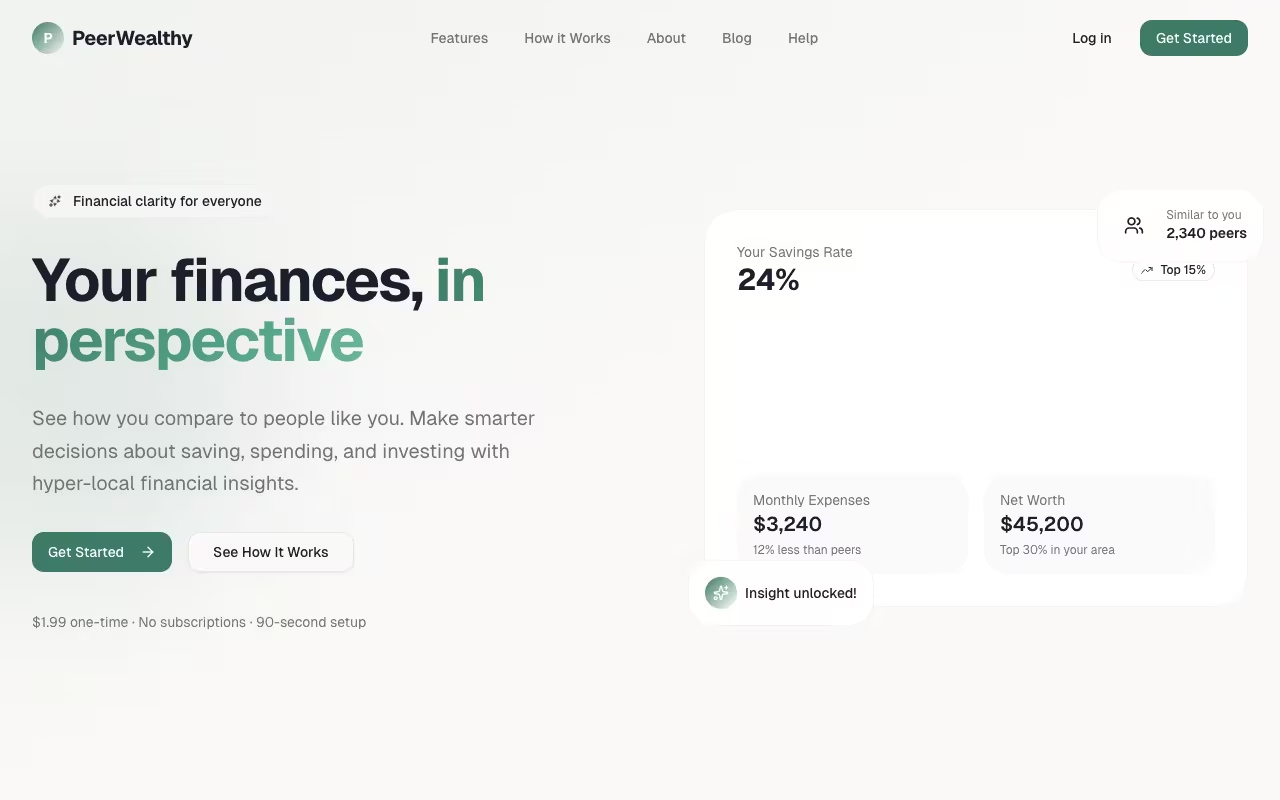
If your product asks people to compare sensitive options, trust has to be visible at the moment of judgment. Here is the framework I am using while building PeerWealthy.

AI can speed up tickets, specs, and prototypes, but product managers still lose the week to delivery. Here is how to reclaim discovery, judgment, and better bets.

When AI can draft specs and prototypes fast, the bottleneck shifts to visible decisions. Here is the product decision system I think AI teams need.

Google now offers AI visibility reporting in Search Console, but SEO and AI search still belong in one operating view. Here is the dashboard I would build.

Google says generative-AI visibility still starts with SEO. Here is what the new guide actually says about AEO, GEO, llms.txt, structure, and what to fix first.

Browser agents need stable layouts, semantic actions, accessible labels, and flows that stay legible when a machine tries to use your site.

A practical framework for PMs and solo builders to judge product ideas when AI makes prototypes fast, cheap, and dangerously easy to overvalue.

A practical landing page conversion optimization checklist for AI-era traffic, covering answer-layer visitors, proof, CTA timing, internal links, trust, and mobile UX.

The fastest path to AI leverage is not handing over your whole business. It is choosing five repeatable workflows, clear rules, and visible review points.

PMs do not need to become full-time engineers, but they do need enough coding fluency to prototype, inspect AI output, and move from idea to artifact faster.

A practical guide for PM teams using AI to triage feature requests, cluster noisy feedback, and draft better routing packets without letting the model decide the roadmap.

A PRD can still align a room, but AI teams need a tighter product spec with explicit bets, constraints, acceptance criteria, and evaluation logic.

A practical guide to structuring pages that AI systems can cite and humans can still convert from, without turning the page into SEO sludge.

The best AI workflows for product managers are repeatable systems for research, prototyping, prioritization, and reporting. Here is what saves time in practice.

Loop engineering is the practice of designing the system that prompts, checks, and improves an agent in a loop. Here is where it fits and what to build first.