How to package a product claim as proof instead of a feature list
Turn a product claim into credible proof by making its boundary, evidence, exceptions, and verification visible at the exact moment a buyer must decide.
 Niels Kaspers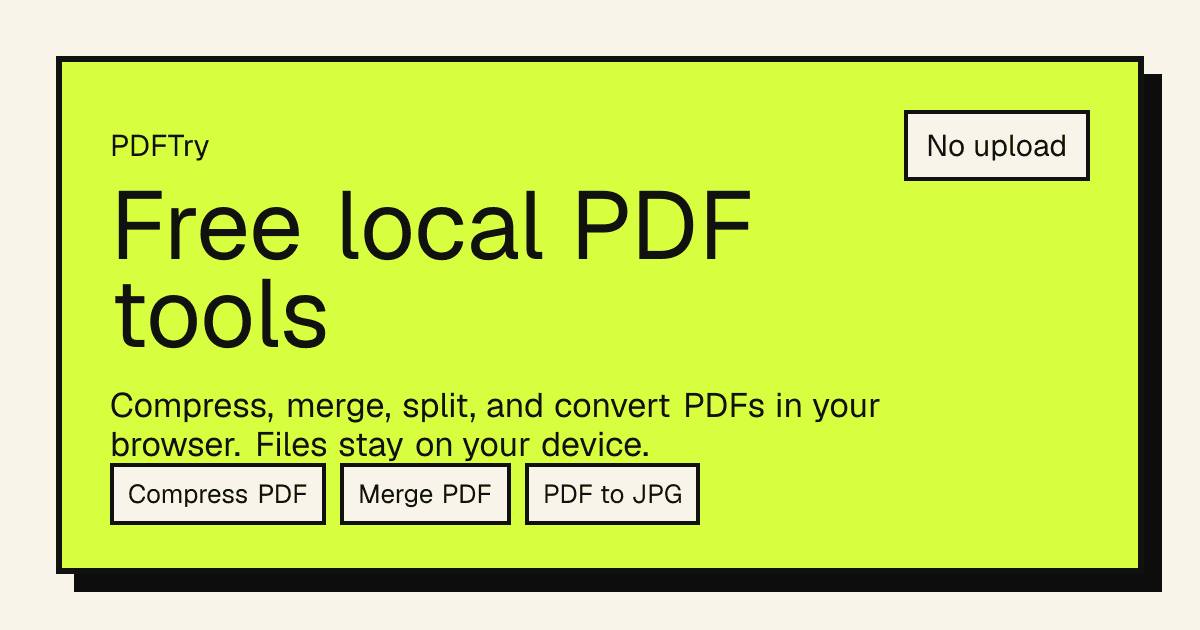
TL;DR
A credible product claim has a visible boundary, observable evidence, honest exceptions, and a way for a buyer to verify it before making the risky decision.
A product claim becomes proof when a buyer can see its boundary, inspect its evidence, understand its exceptions, and verify it at the moment the claim matters.
Most feature pages do the opposite. They make the claim louder: faster, smarter, private, secure, AI-powered. Then they ask the buyer to take the rest on faith. That is not a product argument. It is a feature list with adjectives.
The better question is not “what can we say?” It is “what can a customer actually check before deciding?” A useful claim gives the customer a decision aid. It names the job, shows what happens, and makes the tradeoff legible.
I have been working through that constraint with PDFTry, a browser-local PDF product. Its useful story is not simply that it has many PDF utilities. The defensible claim is narrower: the listed workflows can keep a person's document in the browser. That changes where proof belongs: near the file picker, in the task explanation, and on the pages that explain the product's limits.
Start with a boundary, not an aspiration
A credible product claim says what it covers and what it does not. “Your file stays in this browser for this task” is more useful than “enterprise-grade privacy.” “A reviewable decision record is created after approval” is more useful than “AI that keeps teams aligned.”
Write down four things before you publish a meaningful claim:
- What user job does it change? Name the action or uncertainty the product reduces.
- What does the product actually do? Describe the behavior, not the category adjective.
- Where is the boundary? Be precise about conditions, integrations, and exceptions.
- How can a buyer verify it? Link to evidence and make the behavior observable in the flow.
This is not a legal exercise. It is product clarity. A user who cannot tell what a promise means has been given marketing, not a decision aid.
Put proof where the risk lives
Proof has a timing problem. A detailed page can be accurate and still arrive too late. The buyer decides when they are about to upload a bank statement, delegate a consequential workflow, or invite a team into a new system.
That is where the claim needs to reappear in plain language. For a browser-local tool, a short line below the file picker can do more work than a paragraph in a footer: “Processed locally in your browser. This file is not uploaded for this workflow.” If there are exceptions, name them before the action—not after it.
The same principle applies to product pages. In What building PDFTry taught me about category positioning, I wrote about why a no-upload promise has to shape the product flow rather than live as a slogan. The user should not need to hunt for reassurance after the scary step has already happened.
Make the claim testable, not louder
Trust grows when the product gives people a way to inspect the claim. That does not require turning every visitor into a security reviewer. It does require a clear explanation, consistent product behavior, and no contradictions between page copy and the actual flow.
A useful proof layer includes:
- a task-level explanation of what changes for the user
- observable product behavior or a concrete artifact
- a plain statement of conditions and limits
- a link to technical, policy, or first-party evidence
- copy that stays consistent from landing page to action to result
Google's people-first content guidance asks whether a page makes its sourcing and expertise clear enough to trust. Google’s 2026 guide for generative AI features makes the adjacent point: publicly accessible, crawlable, useful content remains the foundation; claimed AEO shortcuts are not a substitute. The product equivalent is simple: a claim needs visible evidence, not an extra acronym.
Treat exceptions as part of the product
The fastest way to weaken a claim is to overstate it. A workflow may call a third-party service. A file may be stored if a user deliberately saves it to an account. An AI feature may need human approval before it can act. Those are not necessarily problems; hidden exceptions are.
A strong proof layer does not pretend the product has no boundary conditions. It labels them. That makes the main promise more credible because the buyer can tell what it covers.
This is why a narrow claim often beats a broad one. “No file upload for the listed browser-local tools” can be checked. “Your privacy is our priority” cannot. “Every recommendation includes the evidence used” can be checked. “Smarter product decisions” cannot.
Let the claim guide product decisions
Once the evidence is visible, the claim can become a product filter. If a proposed feature requires sending the user's document somewhere else, the team must decide whether to make that exception explicit, keep it separate, or reject the feature. The promise stops being copy and starts shaping the roadmap.
That is useful discipline for small teams. The GOV.UK guidance on prioritisation recommends grounding priorities in evidence, user research, and stakeholder input. If a feature erodes the reason a user chose you, more feature breadth may be the wrong trade.
A clear context layer helps here too. Why your product page needs a context layer, not just a feature grid explains why product pages need to resolve the user’s mental objection before listing capabilities. The objection—not the feature count—is often the real conversion job.
Product-claim proof checklist
Interactive
Product-claim proof audit
Run this before putting a meaningful promise on a landing page or in a sensitive workflow.
Completion
This is the gap between understanding the article and actually using it.
- Use this block as the practical summary, not just the article ending.
- If one item feels vague, the article probably needs sharper guidance.
- A short checklist beats a long recap when the reader needs to act.
The aim is not to make every product sound like a compliance review. It is to make one important promise legible enough that a person can act on it.
FAQ
What makes a product claim credible?
A credible claim describes a user-relevant behavior, states its boundary, provides observable or first-party evidence, and does not hide meaningful exceptions.
Should every feature have a proof block?
No. Prioritize claims that affect trust, risk, purchase decisions, or a product's differentiated position. Routine capabilities usually need clearer explanation, not an evidence dossier.
Where should product proof appear?
Put the short version where the user makes the consequential decision, then link to fuller technical, policy, or product evidence. Do not rely on a generic footer alone.
Does product proof help SEO or AI search?
It is not a ranking trick. It makes the page clearer, more useful, and more evidence-led, which is closer to the people-first standard than a generic feature list.