How to build a comparison product people actually trust
If your product asks people to compare sensitive options, trust has to be visible at the moment of judgment. Here is the framework I am using while building PeerWealthy.
 Niels Kaspers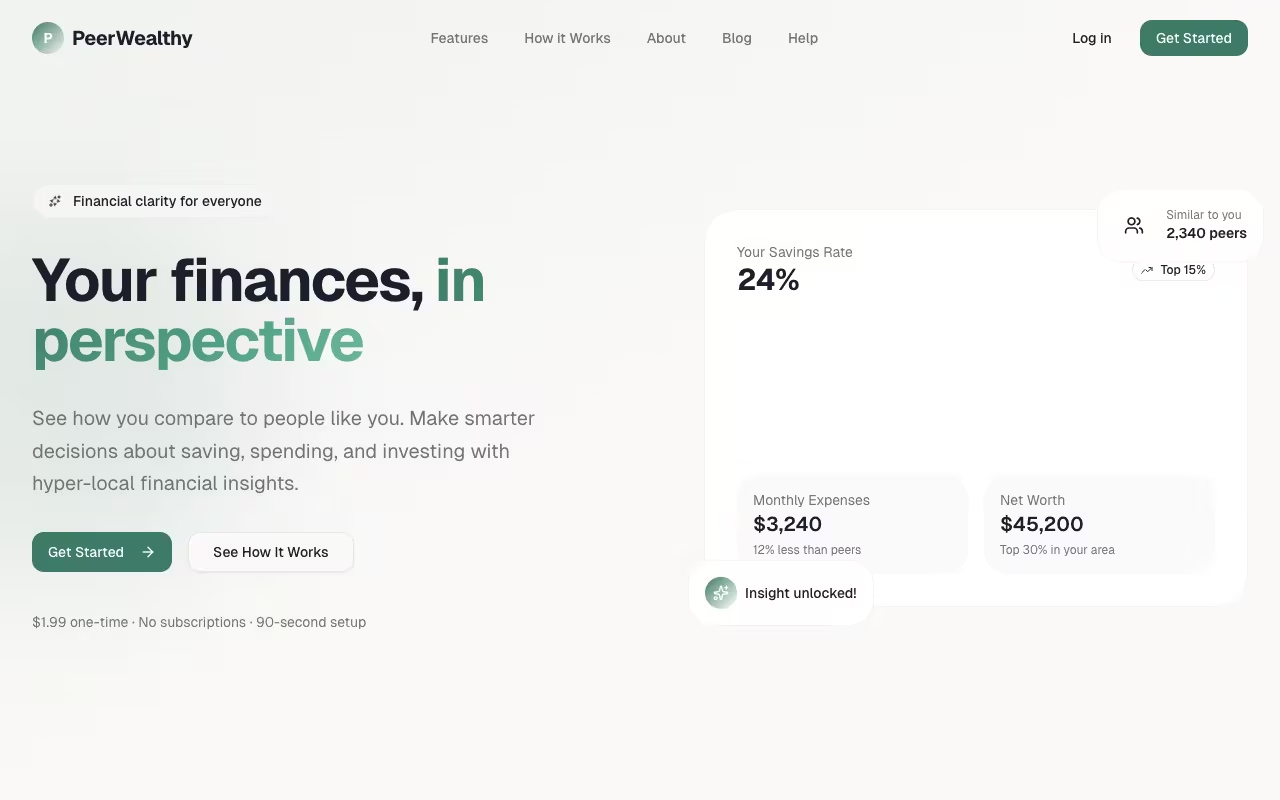
TL;DR
Comparison products fail when they ask for trust too late. While building PeerWealthy, I keep coming back to the same rule: the ranking logic, privacy posture, and source of truth need to be legible before the user makes a judgment call.
If you are building a comparison product, trust is not a nice brand layer you add later.
It is the product.
The user is not only asking, "does this app work?" They are asking whether they should believe the comparison, whether the ranking is fair, whether the product is pushing them somewhere self-serving, and whether the data they give up is worth the answer they get back.
That is why I keep thinking about trust while building PeerWealthy, a product built around a sensitive comparison question: how am I doing financially compared with people like me?
That question sounds simple. It is not.
The moment you ask a user to compare themselves to peers, prices, plans, cards, lenders, salaries, or benchmarks, you are creating a judgment surface. If that surface feels manipulated, vague, or voyeuristic, the product breaks before the feature set matters.
My working thesis is simple: comparison products people actually trust make four things visible before the user commits to the result. They make the dataset legible. They make the ranking logic legible. They make the privacy tradeoff legible. And they make the outcome useful enough that the user would still want the product even without the dopamine hit of the score.
That is the framework I am using right now.
What comparison-product trust actually means
A lot of teams talk about trust too abstractly.
They mean visual polish, social proof, or a clean brand voice.
Those things help, but they are not the core problem.
Trust in a comparison product shows up at the point of judgment.
That is the moment the user asks:
- what am I being compared against
- why did the product choose this comparison frame
- what incentives shape the ranking or recommendation
- what data do I have to give up to get a result
- should I act on what I am seeing
The CFPB's circular on preferencing and steering is useful here because it treats comparison interfaces as a real consumer-protection issue, not just a UX detail. If a product influences the order or framing of options, that logic matters. The user does not experience opacity as a minor annoyance. They experience it as a reason not to trust the output.
That same rule applies beyond regulated finance.
The more personal the comparison feels, the less tolerance the user has for vague methodology.
Why this matters for PeerWealthy specifically
PeerWealthy is not trying to be another broad personal-finance feed.
The product promise is narrower: show people how they compare against relevant peers instead of influencer theater, national averages, or random flex culture.
That promise only works if the comparison feels fair.
A first-party lesson I keep coming back to is that fairness has to be visible before the result, not explained away after it.
If the app simply says, "you rank here," that is not enough.
The product has to signal what kind of peer group is being used, what inputs matter, where the limits are, and what the result should and should not be used for.
That is also why this topic sits naturally beside How to evaluate product bets when AI makes prototyping cheap. Cheap prototyping makes it easier to ship a comparison mechanic. It does not make it easier to earn belief in the output.
The four layers I am using for comparison-product trust
1. The dataset has to feel real before it feels impressive
A lot of comparison products start by trying to look big.
Bigger dataset. Bigger coverage. Bigger market story.
That is often the wrong first move.
For a comparison product, the user cares less about abstract scale than about whether the comparison set feels relevant.
A smaller, more legible cohort beats a giant blurry one.
That is why PeerWealthy works better when the framing stays specific: area, age range, life stage, and other context that makes the benchmark feel earned instead of theatrical.
The job is not to impress the user with volume. The job is to make the comparison set feel appropriate.
That lesson also overlaps with What building PDFTry taught me about category positioning. Positioning gets stronger when the promise becomes specific enough to trust.
2. The ranking logic has to feel explainable in plain English
If the product cannot explain its comparison logic without sounding defensive, it probably is not ready.
Users do not need a giant methodology appendix first.
They do need a plain-English explanation of what drives the result.
What inputs are counted?
What gets normalized?
What is estimated?
What is excluded?
What should the user treat as directional instead of exact?
This matters even more when products are increasingly wrapped in AI language. AI can generate a smoother result page. It cannot substitute for explainable logic.
Google's current AI optimization guide makes a similar point from the content side: clear purpose and useful information beat commodity surfaces. I think comparison products follow the same rule. If the product's core judgment layer is hard to explain, the rest of the polish does not rescue it.
3. The privacy tradeoff has to be visible before the form fill
This is where a lot of products still hide.
They wait until the user is already invested, then reveal what gets collected or how the data is used.
That is backwards.
If trust is part of the product, the privacy posture is part of the value proposition.
Apple's App Privacy Details docs are a useful reminder here. The point of those disclosures is not legal theater. It is to help people understand what data is collected and how it is used before they decide whether the app deserves that access.
For a product like PeerWealthy, that means the user should understand the exchange clearly: what they share, how it is protected, how it becomes part of the benchmark, and what is never exposed back to others.
That clarity is not a compliance footnote. It is part of the onboarding.
4. The result has to create insight, not just a score
A weak comparison product ends in a number.
A stronger one ends in orientation.
The user should leave with some answer to: what does this mean, what should I do next, and how should I interpret the result responsibly?
That matters because scores are sticky but shallow.
Insight is what makes the product worth returning to.
This is also where context layers matter. I wrote earlier about Why your product page needs a context layer, not just a feature grid. Comparison products need the same thing inside the experience itself. The user needs enough surrounding context to trust the output, not just consume it.
What I would avoid in any comparison product
There are three traps I would keep resisting.
Opaque ranking theater
If the product is rearranging options, benchmarks, or peers without explaining the logic, trust decays fast.
Privacy reassurance that arrives too late
If the strongest privacy explanation only appears in the footer or policy page, the user will assume the product is hiding the real tradeoff.
Gamified scoring without responsible interpretation
If the output invites self-judgment without context, it may be sticky, but it will not feel trustworthy for long.
The FDIC's guidance on banking with apps points to the same broader lesson: consumers need clarity about what kind of product they are using and what protections do or do not apply. The trust layer is part of the product surface, not a support article someone reads later.
The audit I am using right now
Interactive
Comparison product trust audit
Use this before shipping any product that asks users to judge themselves, their options, or their rankings.
Completion
This is the gap between understanding the article and actually using it.
- Use this block as the practical summary, not just the article ending.
- If one item feels vague, the article probably needs sharper guidance.
- A short checklist beats a long recap when the reader needs to act.
Why this feels like a real portfolio-expansion topic
I do not want every post on this site to collapse into the same AI operator lane.
This one expands the site in a way that still feels native.
It is still about systems, legibility, and product truth. It just applies those instincts to a first-party product where trust is the core mechanic.
That makes it a better July 19 piece than another same-week reaction to AI workflow discourse.
The overlap risk is lower. The first-party leverage is stronger. And the internal routing is obvious through PeerWealthy, product strategy, and product-evaluation pages.
My broader take
The best comparison products do not win because the score looks clever.
They win because the judgment path feels fair.
That is the standard I keep coming back to while building PeerWealthy.
If the cohort feels real, the logic feels explainable, the privacy exchange feels visible, and the result gives the user useful orientation, the product has a real shot at trust.
If any of those layers stay fuzzy, the product may still get curiosity clicks, but it will struggle to earn belief.
And in trust-sensitive categories, belief is the product.
FAQ
What makes a comparison product trustworthy?
A trustworthy comparison product makes the dataset, ranking logic, privacy tradeoff, and interpretation layer visible before the user has to rely on the result.
Why is PeerWealthy a good example for this?
Because it asks people to make a sensitive judgment about their financial standing. That creates a high bar for fairness, privacy clarity, and responsible interpretation.
Is this only relevant for fintech products?
No. The same rules apply to any product that ranks options, benchmarks performance, or compares users against peers, including hiring tools, shopping tools, salary tools, and recommendation products.
Why is ranking transparency so important?
Because users treat opaque rankings as manipulation risk. If the product cannot explain why an option or result appears the way it does, trust drops quickly.
What is the biggest mistake comparison products make?
They treat trust like marketing polish instead of product architecture. By the time the trust explanation arrives, the user has already decided whether the result feels believable.