Why local-first is a better product story than \"we use AI\"
Local-first positioning earns trust when it names the processing boundary, the user job, and the trade-offs—rather than hiding behind a generic AI claim.
 Niels Kaspers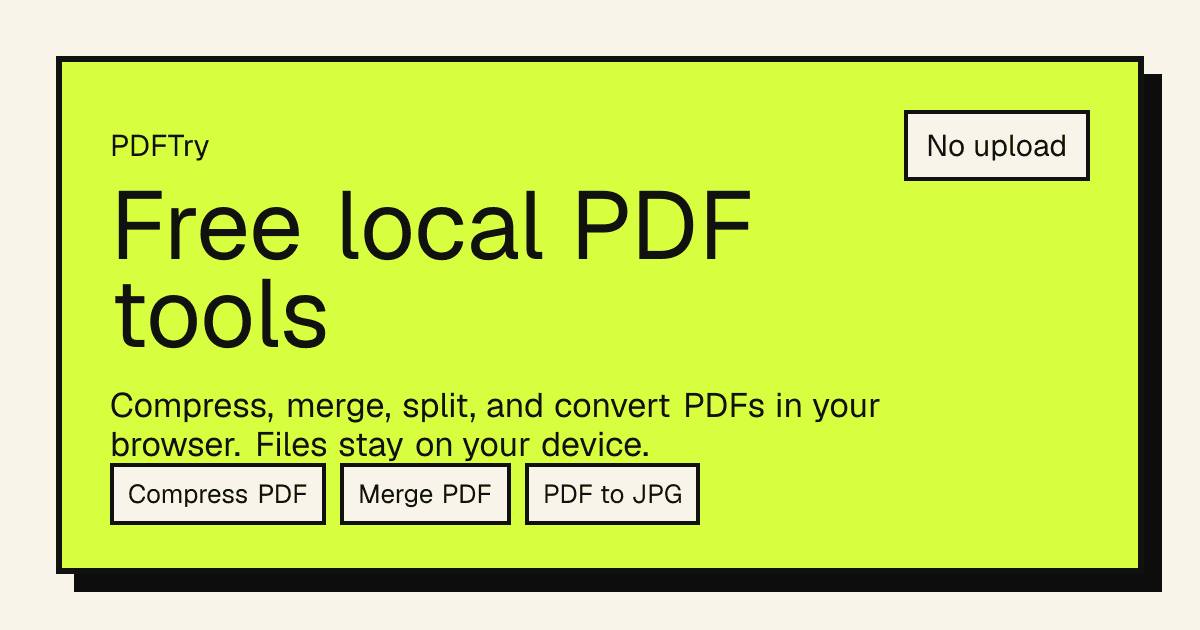
TL;DR
“We use AI” is not a product position. A local-first product story becomes credible when it states what remains on the device, what leaves it, which user job gets easier, and where the boundary changes.
What makes local-first a real product strategy?
Local-first is a real product strategy when it gives a person a better reason to choose the product: a clearer privacy boundary, less waiting, a more reliable offline path, or confidence that a sensitive file does not leave their device. It is not a strategy when it is a vague architecture badge beside the same generic feature list as everyone else.
That is why “we use AI” has become such a weak product story. It describes a commodity ingredient, not the job a customer can finish or the risk they can avoid. A product earns attention when it says what happens to the user’s work, where that processing happens, and what the user can expect when the boundary changes.
I have learned this from building browser-local tools including PDFTry and ScreenshotEdits. The useful promise is not that the product has an impressive stack. It is that someone can complete a narrow, sensitive workflow without first handing an unknown service their document or screenshot. That is a product decision, a trust decision, and a positioning decision at the same time.
Start with the user job, not the architecture
A local-first story needs a finishable job. “Edit a screenshot before sharing it” is a job. “Make a PDF usable without uploading it” is a job. “We process data locally” is not a job; it is an implementation detail until it changes what the person can safely do.
This distinction matters because a product can be technically local and still hard to understand. The user should not have to infer why a processing boundary matters. Put the consequence in plain language: the file stays in the browser, the output is available immediately, or the workflow works without creating another account.
The same discipline applies to every product claim. In the proof-block framework, I make the case for pairing a promise with evidence, scope, and a decision. Local-first claims deserve the same treatment. If a file never leaves the device, say so. If analytics, collaboration, or a premium model requires a network call, say that too. Trust comes from a legible boundary, not a maximal claim.
Make the processing boundary visible
The most valuable local-first product copy answers four questions before a user has to ask them:
- What stays on the device?
- What, if anything, leaves it?
- When does the boundary change?
- What does the user gain or give up because of that choice?
A recent local-first product strategy essay makes an important operational point: a local-first promise needs explicit device tiers, capability disclosure, and graceful degradation. That is the difference between saying “private” and giving someone a reliable expectation.
For browser-local products, this can be remarkably concrete. A PDF conversion flow can state that the document is processed in the browser. A screenshot editor can state that the image remains on the device until the user explicitly exports or shares it. A collaborative product can explain which actions sync and why. The boundary is not an FAQ footnote. It belongs near the moment when a user decides whether to begin.
That is also why a no-upload trust layer is more than a compliance pattern. It converts an internal technical choice into a visible reason to trust a workflow.
Do not confuse local-first with feature maximalism
The temptation is to turn a local-first product into a broad platform: editing, storage, collaboration, generation, automation, and every future use case in one interface. That usually weakens the story. Each additional capability introduces a new permission, failure mode, explanation, and maintenance burden.
Current product-management work on feature bloat recommends looking at feature usage, active features per user, time to first value, and retention by adoption. Those are useful checks because they bring the decision back to behavior. A feature that makes a pitch deck look complete can still make daily use slower and the core promise less credible.
The practical test is simple: does this addition help the user complete the central job more reliably, or does it make the product harder to explain? If the answer is unclear, the right next move is usually not “ship and see.” It is to protect the core loop, observe where people stall, and add evidence before adding surface area.
That is the product lesson behind ScreenshotEdits: a small tool becomes more useful when it protects one finishable workflow. It does not need to impersonate a whole design suite to earn a place in someone’s day.
Turn the local-first choice into a positioning sentence
A strong category sentence has three parts: the user, the finishable job, and the meaningful boundary. For example: “Prepare a shareable screenshot in your browser, without uploading the original image.” It does not lead with infrastructure. It leads with an outcome and makes the trust condition easy to understand.
Use the sentence to pressure-test the rest of the product. If the home page, onboarding, pricing, and support answers all describe different jobs, the architecture cannot rescue the position. If the sentence becomes vague once you remove the word AI, the position is likely still borrowing its meaning from a trend.
A useful way to draft this is to write three versions:
- The outcome sentence: what can the user now finish?
- The boundary sentence: what stays private, local, or under the user’s control?
- The trade-off sentence: what does the product intentionally not do?
The third sentence is often the differentiator. It shows restraint. It also prevents a team from promising universal capability when a narrower, more dependable workflow is the reason the product should exist.
Interactive
Local-first positioning check
Use this before turning a privacy or AI claim into product copy.
Completion
This is the gap between understanding the article and actually using it.
- Use this block as the practical summary, not just the article ending.
- If one item feels vague, the article probably needs sharper guidance.
- A short checklist beats a long recap when the reader needs to act.
Use proof where the decision happens
A promise is strongest when the proof appears near the action. Put a no-upload statement beside the file picker. Put device requirements beside the download. Put collaboration limits beside the invite button. Put the data boundary in the share flow rather than asking a buyer to hunt through a policy page.
This does not mean hiding every limitation. A trustworthy product makes the limitations legible too. If a workflow needs a server for collaboration, a large model, or durable storage, explain what moves and why. The goal is not to claim that nothing ever leaves a device. The goal is to let the customer make an informed choice before committing their work.
The broader positioning lesson is durable: a specific boundary is easier to believe than a generic advantage. “We use AI” asks a customer to imagine value. “Your document is processed in the browser for this task” gives them a claim they can inspect.
FAQ
Is local-first always better for an AI product?
No. Collaboration, large models, and shared systems of record can require remote services. Local-first is useful when the local boundary improves the user’s trust, speed, reliability, or control enough to matter for the job.
How should a product explain its privacy boundary?
Use plain language near the relevant action. State what remains on-device, what leaves it, when that changes, and the practical consequence for the user.
Can a local-first product still use AI?
Yes. The question is not whether AI exists in the stack. The question is whether the product makes its processing and data boundary understandable, and whether the AI capability improves a clear user job.
What is the fastest way to test whether the local-first story works?
Ask users to repeat the product’s outcome and trust boundary after reading the first screen. If they can explain both without technical jargon, the position is doing useful work. If they only remember that the product “has AI,” the story needs more focus.
Local-first positioning works when it turns an invisible product choice into a visible customer benefit. Name the job, make the boundary inspectable, and protect the core loop. That is more memorable—and more defensible—than another generic AI claim.