What I am learning from building PeerWealthy before launch
Building PeerWealthy is teaching me that a financial comparison product must earn trust through clear cohorts, consent, and honest limits before growth can matter.
 Niels Kaspers
TL;DR
PeerWealthy is making one lesson clear before launch: a comparison product earns its right to grow by making its cohort, data boundary, and limits understandable before it shows a score.
Building PeerWealthy before launch is making one product lesson much clearer for me: in a comparison product, trust has to arrive before the insight.
The surface question is simple. How am I doing compared with people like me? The product question is harder. What kind of comparison will help a person orient themselves without pretending that a score is a verdict on their life?
That distinction matters because most financial comparison is noisy. People compare themselves with influencers, a small group of friends, or national averages that erase location, stage, household context, and tradeoffs. None of those sources is a useful benchmark. They can still shape behavior.
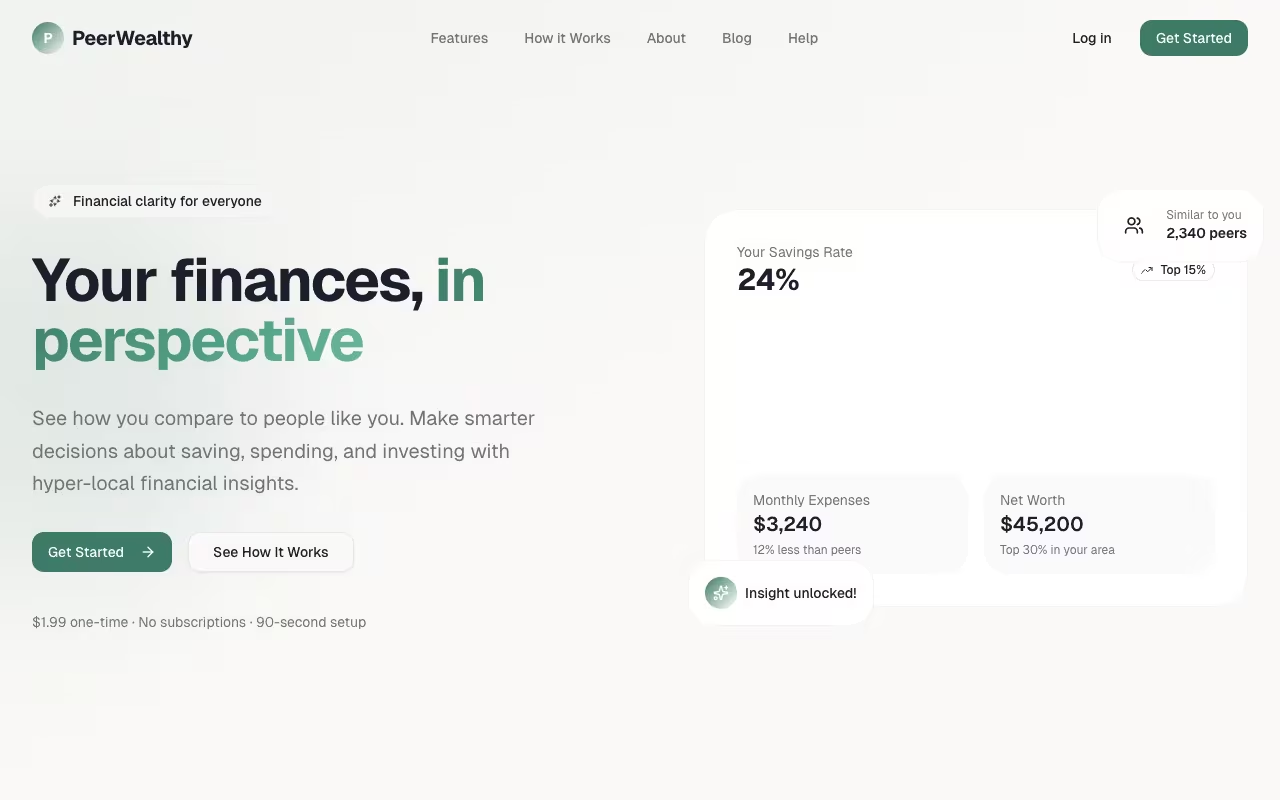
My first-party receipt is PeerWealthy: an in-development product built around hyper-local, stage-aware financial comparison. The job is not to tell people that they are winning or losing. It is to make a bounded comparison legible enough that someone can decide what to inspect next.
A benchmark is only useful when its frame is visible
A score without a frame creates false precision. Before showing a result, a comparison product should explain who is included, which variables influence the grouping, what is deliberately excluded, and how much confidence a user should attach to the result.
That does not mean publishing a methodology paper before a person can use the product. It means using plain language where the decision happens. If age, location, income band, household stage, or declared goals change the cohort, say so. If the product cannot make a meaningful comparison yet, say that too.
The Consumer Financial Protection Bureau's guidance on digital comparison tools is a useful reminder that comparison interfaces carry real responsibility. When a tool looks neutral while its ordering or recommendation logic serves another incentive, users can be steered without understanding why. PeerWealthy is not a product-ranking engine, but the underlying product lesson is the same: do not ask users to trust an unexplained comparison.
Explain the data boundary before asking for the data
Financial context is not just another onboarding field. A person who shares income, savings, debt, or location is taking a meaningful trust step. The product should make three things clear before that step: what it needs, why it needs it, and what the person can later change or remove.
The CFPB's guidance on sharing financial data is practical here. People should be able to understand how data is accessed, what is stored, how long it is retained, and how access ends. Those are not legal-footer details. They are part of whether a comparison feels safe enough to use honestly.
For PeerWealthy, that means resisting the urge to ask for every possible variable because it might improve a future model. The product should request the smallest useful set, explain the reason beside the request, and let the user understand the difference between anonymous cohort contribution and a personal profile. Better data is not an excuse for more opaque collection.
Design for orientation, not performance theater
The failure mode for a comparison product is easy to see. It turns a complicated situation into a leaderboard, then makes repeat checking feel like progress. That might create activity, but it does not necessarily create clarity.
The version I want PeerWealthy to become has a calmer job. It should help someone understand the benchmark, identify the variable that deserves attention, and leave with a next question rather than a permanent label. A result can say that a person is below a cohort range without implying they have failed. It can point to housing cost, debt load, emergency savings, or a different stage of life without prescribing a universal answer.
This is where the product connects with the broader lesson in How to build a comparison product people actually trust. The useful comparison is not the most dramatic one. It is the one a user can inspect, contextualize, and use without being manipulated into shame or false confidence.
The early product work is a trust architecture
Before launch, it is tempting to measure progress by feature count: another dashboard, another calculation, another sharing loop. The more important work is quieter. Define the cohort. Test the language around anonymity. Decide what a benchmark does not mean. Make it obvious how a person can correct or remove information.
That is product work, not compliance cleanup. It shapes whether the data flywheel is worth building at all. If people do not understand what they contribute or how their result is produced, adding more sophistication only makes the black box more polished.
It is a lesson I have also seen while building PDFTry. A trust promise works when the boundary is visible at the moment a person has to act, not when it is buried in a generic policy page. The details differ, but the pattern is the same: name the exchange, name the limit, and make the next step inspectable.
A practical check before shipping a comparison feature
Interactive
Comparison-product trust check
Use this before you ship a benchmark, ranking, or recommendation that asks a person to trust an unseen model.
Completion
This is the gap between understanding the article and actually using it.
- Use this block as the practical summary, not just the article ending.
- If one item feels vague, the article probably needs sharper guidance.
- A short checklist beats a long recap when the reader needs to act.
Building in public should produce a reusable lesson
I do not want this to become founder journaling with a product name inserted into every paragraph. The useful lesson extends beyond personal finance. Any product that compares a user with a group, ranks options, recommends a next move, or converts private inputs into a visible result has to earn the right to be believed.
Start with the decision a user is trying to make. Then show enough of the model for them to understand the boundary. Keep incentives visible. Ask for less data when less data will do. Let people challenge the result. That is a stronger foundation than a clever score.
FAQ
What is PeerWealthy trying to solve?
PeerWealthy is trying to give people a more relevant financial comparison than influencers, generic national averages, or mismatched peers. The aim is orientation, not a verdict.
Why does a financial comparison product need to explain its cohort?
Because a benchmark is meaningful only when a user can tell who is included and which factors shape the comparison. Otherwise a precise-looking number can create false confidence or unnecessary anxiety.
Should a comparison product collect every variable that could improve its model?
No. It should collect the smallest useful set, explain why each sensitive input is needed, and make retention, access, correction, and removal understandable.
How can a product avoid turning comparison into performance theater?
Frame the result as a bounded signal, show its limitations, avoid shame-based ranking, and help the user choose a useful next question instead of encouraging endless checking.