When should a small software tool charge once instead of monthly?
Choose one-time pricing when a small software tool delivers a bounded job with bounded costs; use recurring pricing only when ongoing value is real.
 Niels Kaspers
TL;DR
A small software tool should charge once when it completes a durable job, has bounded marginal cost, and does not need a recurring service promise to stay useful. A subscription earns its place when the customer receives continuing value that requires continuing work: fresh data, hosted collaboration, ongoing infrastructure, or a service that improves over time.
A subscription is not a sign that a software product is more serious. It is a promise: the customer will keep receiving enough value that a recurring charge feels fair. If you cannot name that continuing value, a monthly price is usually a tax on a completed job.
That distinction matters most for small tools. A screenshot formatter, file converter, offline utility, or narrow desktop app can be genuinely useful without becoming a service business. The right question is not "Can we add a subscription?" It is what keeps getting better, refreshed, hosted, or supported after the first completed job?
For one-time pricing for software, use a simple test: charge once when the core job is durable and the ongoing cost is bounded. Charge monthly only when the product keeps doing meaningful work for the customer after the initial purchase.
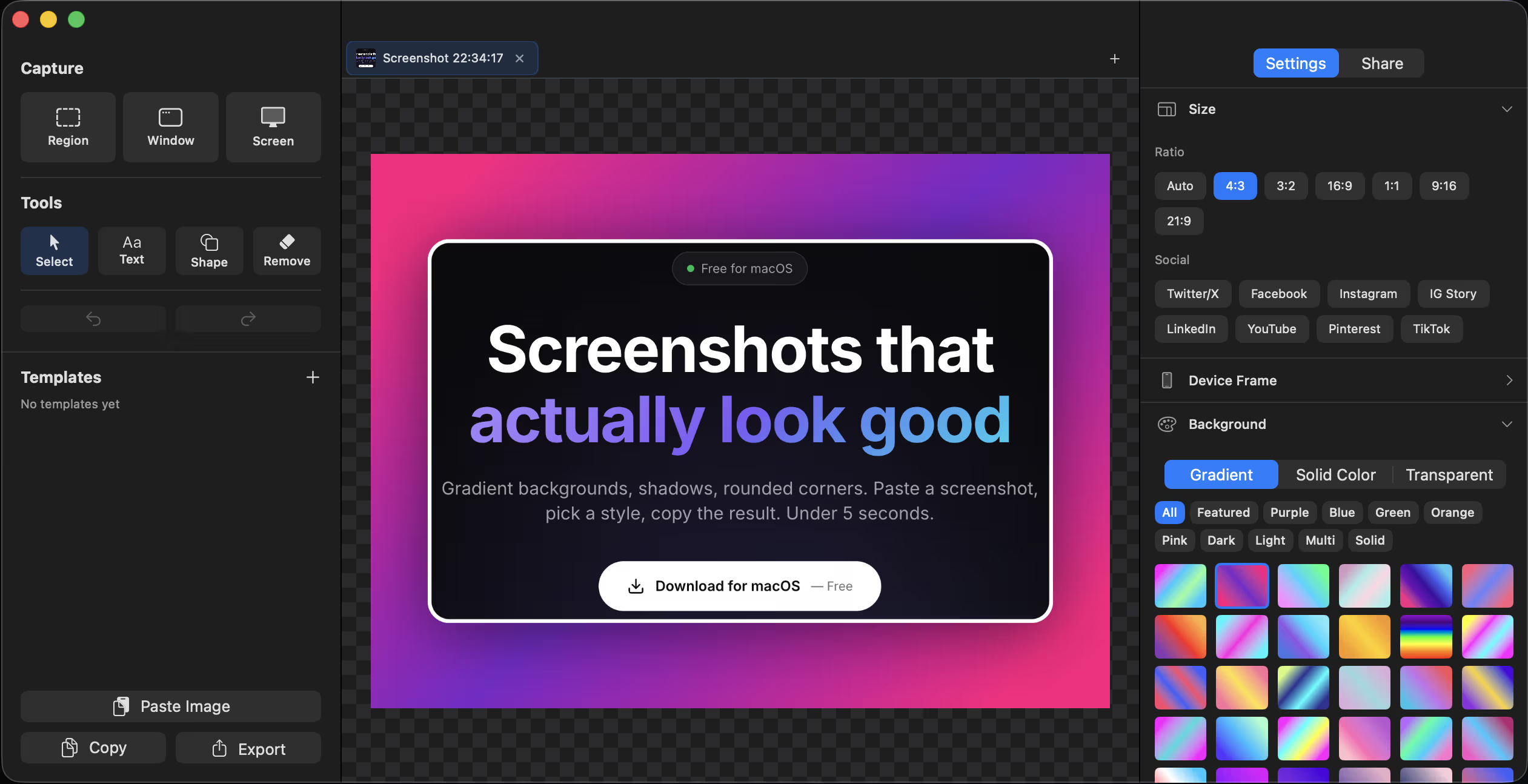
ScreenshotEdits is the first-party example behind this rule. It is a native macOS tool that turns raw captures into polished visuals. The useful outcome is local: make a screenshot ready for a doc, launch post, or presentation. Its free version handles the core workflow; the €19 license removes the watermark and supports development. That is a product decision tied to the job, not a claim that every maker should copy a price point.
Stripe's pricing guidance makes the broader point: pricing should match the value a customer receives and the business model that delivers it. Apple’s in-app-purchase documentation makes the implementation difference explicit too: a non-consumable purchase is bought once and does not expire, while an auto-renewable subscription is access for a repeating period. The billing primitive is easy. The harder part is making the promise honest.
Start with the completed job, not the revenue target
A product can be used frequently and still be a poor subscription candidate. Frequency is not the same as recurring value. Someone may open a screenshot tool every week, but if the product works locally, requires little ongoing infrastructure, and does not materially change between uses, a recurring fee can feel disconnected from the job.
Write the completed job in one sentence before choosing a model:
When a person has a raw screenshot, this helps them create a presentation-ready visual without opening a design tool.
Now ask what must continue for that promise to stay true. If the answer is mostly "the app needs to keep working," that is not automatically subscription value. Reliability, bug fixes, and compatibility are real obligations, but they are not enough by themselves to justify an indefinite charge. A one-time product can reserve money for maintenance, sell meaningful upgrades later, or offer optional support.
A subscription has a stronger case when the sentence includes a continuing service:
- keeps a team’s shared workspace current
- processes new documents or transactions every month
- hosts collaboration, sync, permissions, or audit history
- supplies changing data that the customer cannot reasonably keep locally
- operates a workflow whose quality improves through ongoing review
That is why local-first product positioning matters before pricing. If a product’s best promise is that a sensitive job stays on the device, adding a hosted account just to create recurring revenue can weaken the very reason a customer chose it.
The four costs that should decide the model
Do not pick a price by copying the nearest competitor. Separate the costs created by each active customer.
1. Marginal infrastructure cost
Does every use create inference, storage, bandwidth, third-party API, or compliance cost? If so, a recurring or usage-based component may protect the product. If the tool runs locally after download, the marginal cost may be close to zero.
2. Continuing product work
What do users receive next month that they could not receive today? New data, shared features, managed reliability, or regularly improved output can be real recurring value. A vague intention to ship updates is not a value proposition.
3. Support and trust cost
Some products have small compute costs but significant ongoing obligations: recovery, moderation, policy, security, billing support, or team administration. Price for those obligations honestly. Do not hide them behind a simple-looking license.
4. Switching and ownership cost
The more a person entrusts you with a workflow, files, or business record, the more clearly you should explain what they own, what continues, and what happens if they stop paying. Stripe’s subscription-pricing guide similarly emphasizes clear value propositions and transparent billing terms.
The useful result is not a spreadsheet that mechanically says "subscription." It is a model that aligns the bill with the burden and benefit a customer can actually see.
A practical decision rule for one-time pricing
A one-time price is usually the cleaner choice when all or most of these statements are true:
- the user can finish the core job without a hosted account
- the product’s marginal cost does not rise much with use
- the useful output belongs to the customer and remains usable locally
- the product is not making a time-sensitive promise that needs constant operations
- an update is a bonus, not the only reason the tool works
- the buyer can understand exactly what they get in one sentence
This does not mean the product is "set and forget." A good small tool still needs compatibility work, bug fixes, and product judgment. It means the commercial promise matches a durable artifact rather than inventing a monthly relationship the product does not need.
For ScreenshotEdits, the core job is bounded: take a capture, make it usable, move on. That is why the product surface can be direct about the free workflow and the one-time upgrade. It is also why the product needs visible proof of the result. The screenshot-proof framework is relevant here: before someone pays, they should be able to inspect the job and the state change, not infer them from feature labels.
When a subscription is the honest answer
Do not treat one-time pricing as morally superior. A subscription is better when it funds a continuing service the customer expects. That could be a collaborative product with permissions and history, an AI workflow that consumes model calls and needs quality review, a research database that becomes stale without maintenance, or a security product that must respond to changing threats.
The test is counterfactual: if the maker stopped operating the product for three months, would the customer lose a material part of the value? If yes, say so and price the ongoing service. If no, reconsider whether recurring billing is carrying more of the business ambition than the customer benefit.
This is also a product-scope test. A monthly price should not pressure a maker into adding noisy dashboards, artificial quotas, or feature churn just to make the invoice feel deserved. The better move may be a narrow one-time tool, an optional paid upgrade, a separate hosted product, or a clearly bounded usage add-on.
Interactive
One-time vs. monthly pricing check
Run this before choosing a billing model for a small software product.
Completion
This is the gap between understanding the article and actually using it.
- Use this block as the practical summary, not just the article ending.
- If one item feels vague, the article probably needs sharper guidance.
- A short checklist beats a long recap when the reader needs to act.
Keep the offer legible
Whichever model you choose, make the tradeoff easy to inspect. Put the finished job before the plan names. State whether the product works offline, what is included, what happens after purchase, and which future work is a promise versus an intention. Avoid presenting a non-essential subscription as the only way to complete a fundamentally local task. Avoid presenting a one-time license as permanent hosted service if that service has real continuing costs.
Small products earn more trust when the commercial model is part of the product story. A clear offer lets a buyer decide quickly, protects the maker from an unsustainable promise, and keeps product scope tied to real value.
FAQ
Is one-time pricing good for software?
It can be excellent for software that completes a durable, bounded job with low marginal operating cost. It is a poor fit when the product depends on ongoing hosting, fresh data, collaboration, or operations that customers continue to receive.
How do I know if my product needs a subscription?
Name the concrete value a customer gets after the first month. If it depends on your ongoing infrastructure, data, service, or review work, a subscription may be appropriate. If the answer is only that the app remains installed, a one-time model or paid upgrade may be clearer.
Can a one-time app still charge for upgrades?
Yes. A one-time license can cover a defined version or core product, while major upgrades, optional hosted services, or add-ons have separate, transparent prices. The important part is making the boundary clear before purchase.